LinkedIn

“Connect my PPC account to ChatGPT” sounds like one switch. Microsoft Advertising’s September–November 2026 record shows why I’d treat it as three decisions: permission to read, permission to import, and permission to change bidding.
A reporting connection can tell me what spent without telling me whether a scheduled import will reactivate a campaign I paused. An import can copy settings into Microsoft without answering whether those settings make sense in a different auction. And new bidding guidance can give me a reason to review a setting without giving ChatGPT permission to change it. Roll those decisions into “connect Bing Ads” and I’ve written a vague instruction with a budget attached.
I’d use the dates below to write the operating brief before picking a connector. If all I need is an account diagnosis, I can stop at read access. If I want the AI to act on what it finds, I need to say exactly what it may do and what still requires my approval.
September 23: Put scheduled imports on the inventory
On September 23, PPCChat warned against treating Microsoft as an emergency holiday channel. The point was blunt: peak season is a bad time to ask a platform you’ve barely tested to tell you what works. PMax, AI Max for Search, and Copilot offer features don’t make Microsoft a copy of Google Ads. It’s a different auction, with different volume and placements and less room for sloppy setup.
That warning changes the first thing I ask ChatGPT to do. Before I ask it why a campaign spent what it did, I want to know whether a Google import is scheduled, which settings it copies, and which campaigns are supposed to stay paused. If the import is set to copy budgets, bids, or statuses, it’s not just a shortcut for setting up the account. It’s a standing instruction. A manual fix in Microsoft doesn’t change that instruction.
Inventory first, performance analysis second. I’d ask ChatGPT to list what it can inspect: campaigns, ad groups, keywords, budgets, and change history. Then I’d ask for a separate list of import settings I still need to check by hand. If it can’t see the import schedule, I want “I can’t see the import schedule,” not a confident explanation of what happened. That gap is a finding, not a footnote.
September 30: A buyer alleges nearly $800 in unexpected import spend
In a September 30 Trustpilot review, a buyer alleged that an unexpected Meta import spent almost $800 in roughly three hours. That’s one buyer’s account, not a verified platform fault. The public record is thin. I wouldn’t use the review to explain how Meta imports behave, but I would use it to ask a blunt question: who approved the campaign to go live?
Microsoft’s support material describes a separate, specific mechanism for scheduled Google imports. If a campaign is still enabled in Google, a scheduled import can overwrite its paused status in Microsoft unless campaign status is unchecked under advanced import options. That doesn’t explain what happened to the Trustpilot reviewer. It does explain why “I paused it in Bing” isn’t the end of the conversation when a scheduled Google import can still copy status.
Permission to analyze a source account is not permission to import from it. Here’s the line I’d put in the brief:
Do not import, create, or activate campaigns. List the exact proposed destination changes first.
That list should name the source account, the destination account, the campaigns involved, the settings that would change, and whether new items would arrive paused or active. “Import these campaigns” leaves the last part wide open. I’d rather make the AI spell out what happens in the destination than find out from the spend column.
October 1: The Maximum CPC option changes for new campaigns
From October 1, 2026, Maximum CPC is unavailable for new non-portfolio campaigns using Target CPA, Target ROAS, Maximize Conversions, Maximize Conversion Value, or Maximize Clicks. Existing pre-October campaigns keep their settings. That distinction matters more to an account audit than a blanket statement about whether Microsoft supports a cap.
Review existing settings separately from settings available for new campaigns. If ChatGPT finds a Maximum CPC setting on an older campaign, I don’t want it to assume I can carry that setting into a new one. I also don’t want it to flag the older campaign as broken just because the option is no longer available for a new campaign in the same situation. The useful output is a comparison: what the account has now, what would be available on a new campaign, and what decision, if any, I need to make. None of that requires a bid edit.
October 20: Microsoft documents what its MCP can read, not change
On October 20, Microsoft updated its Advertising MCP tools documentation. The tools retrieve campaigns, ad groups, ads, keywords, asset groups, audiences, and accounts. They support filtering, sorting, and performance reporting, and they can pull change history for the last 180 days. The sentence I’d put on every connector page that uses the word connect: the tools return information and never modify account data.
Microsoft’s MCP use cases follow that boundary. They cover campaign reporting, keyword and audience analysis, asset review, anomaly detection, change history, and Google versus Microsoft comparisons. There’s no campaign creation, import, budget edit, or launch. If a vendor page says Microsoft’s official MCP can make those changes, I’m going with Microsoft’s tools page.
That makes the official MCP useful for the first job. I’d follow the documented ChatGPT setup, verify the account IDs, and ask something I can check: “Which keywords spent money without a conversion in the last 30 days?” or “What changed in this account since the 12th?” Those are requests for evidence, not requests to fix whatever turns up.

If I only need answers, Microsoft’s read-only MCP does the job. If I want ChatGPT to act on those answers, I’d choose groas for that job rather than expect the official MCP to do something it can’t. With groas, ChatGPT can inspect Bing Ads and other channels, propose changes, and execute the changes I approve. Each change is logged with its reason and can be undone in one step. Autopilot stays off unless I switch it on. I want the diagnosis first and a separate decision about what to do with it.
October 28–November 2: A tracking complaint puts CPA comparisons on hold
A Shopify merchant’s complaint about Microsoft conversion capture remained publicly unresolved from late October into early November. Microsoft offered support, but there was no published resolution. That isn’t enough to call it a platform problem. It is enough to know what I’d check before asking ChatGPT to judge Bing on cost per acquisition.
Check the measurement before comparing CPA. I’d ask ChatGPT to separate what it can verify from what I still need to check:
- Is the UET tag active, and has it seen data in the last seven days?
- Is the conversion goal recording the intended event, and is purchase revenue coming through?
- Is the goal included in conversions so bidding uses it?
An active tag doesn’t prove purchase revenue is arriving. A goal excluded from “Include in Conversions” can collect data without driving bidding. And a new tag can take up to 24 hours to verify. Those are different gaps, and I don’t want ChatGPT to flatten them into “Bing didn’t convert.” If the account data can’t settle those checks, I’d hold the verdict. The comparison of AI PPC setups for Google and Bing analysts is useful once there’s enough measurement evidence to compare the channels.
November 18: Microsoft gives me a reason to review bidding, not rewrite it
On November 18, Microsoft published new automated bidding guidance. For accounts with at least five conversions, it recommends starting new campaigns on conversion-based bidding rather than Enhanced CPC. It also says keeping a Maximum CPC is “not recommended” because the cap overrides CPA or ROAS targets even when it sits above the average CPC. That’s the recommendation. The October 1 cutoff is the separate rule about where the setting is available.
For advertisers using Maximize Conversion Value or Target ROAS, Microsoft reported 10% more conversion value per click at similar ROAS, on average. The footnote matters: Microsoft’s internal data, Global Search and Audience Network, August 2026. Search Engine Land’s summary identifies the result the same way. It’s a reason to look at the settings, not a forecast for my account.
Five conversions is a starting point in the guidance. It doesn’t, by itself, make the case for removing an existing cap in a thin account where one expensive click matters. I’d ask ChatGPT to compare the current settings with the guidance, identify where they differ, and tell me what it would change and why. Then I’d decide. The 2026 bidding strategies guide gives me the mechanics of manual CPC, tCPA, and tROAS if I need them before making that call.
Today: Write the operating brief before connecting anything
September puts scheduled imports on the checklist. October gives me a connection that can read the account without modifying it. November gives me new bidding guidance, not a standing order to apply it. So I start with the same three decisions: what ChatGPT may read, what it may import, and what bidding changes it may make. I also name campaign creation and activation explicitly. Neither belongs inside a general instruction to “help with the account.”
I’d write the brief first, connect the relevant accounts, verify the IDs ChatGPT can see, and start with analysis: what spent, what converted, what changed. If I want approved execution, I’d use groas and leave autopilot off. The log tells me what changed and why, and undo reverses a change. It doesn’t refund what’s already been spent. That’s why approval belongs before the click.
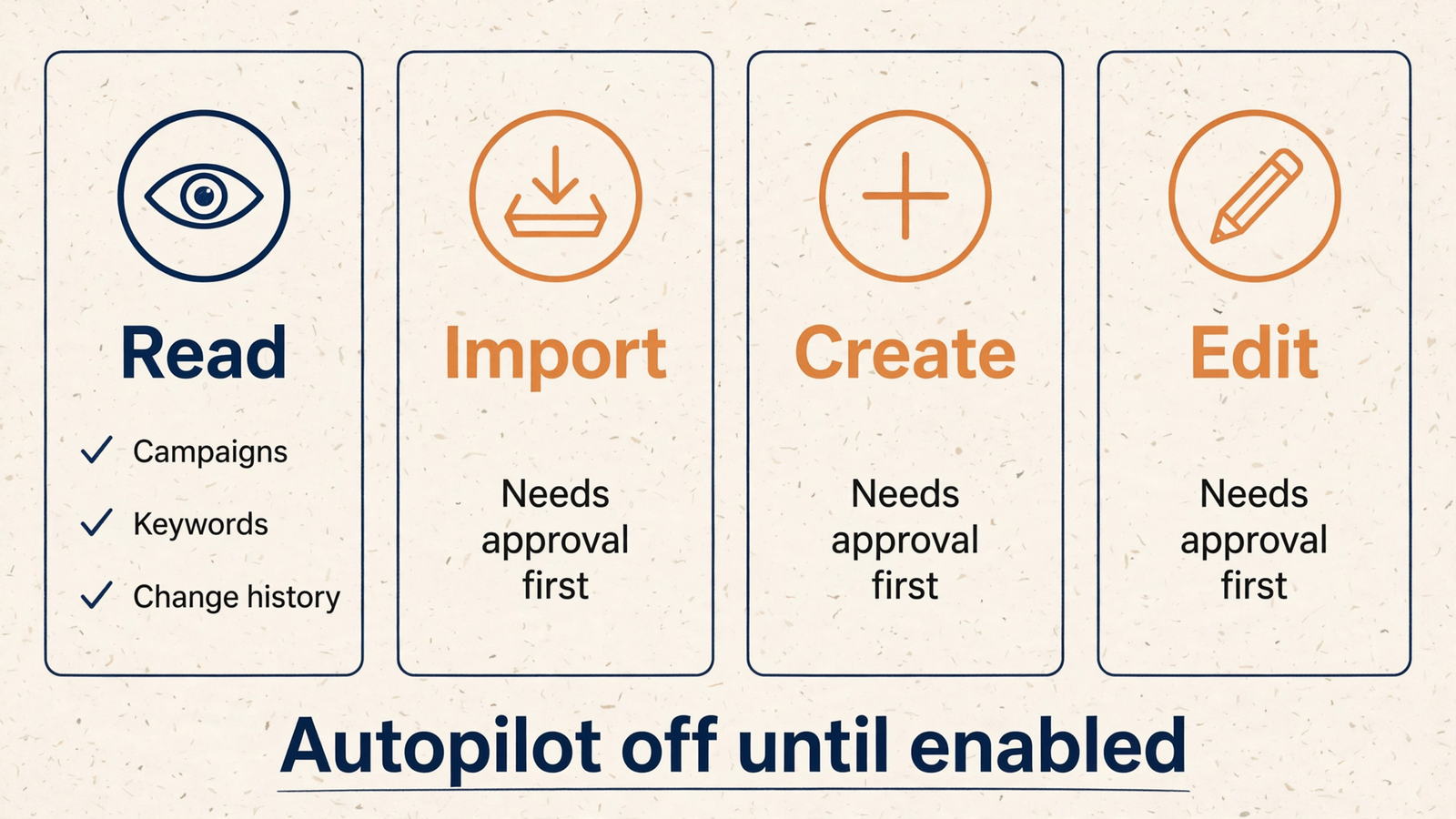
The four lines I’d give ChatGPT
- Read the verified accounts only. Inspect campaigns, keywords, spend, conversions, and change history. Report what spent without converting and flag measurement you can’t verify.
- Do not import. If you propose an import, list the source and destination accounts, the campaigns, the settings that would change, and which items would be active or paused.
- Do not create or activate campaigns. If you propose either action, name the campaign and the exact destination account.
- Do not edit bids or budgets without approval. Show me the current and proposed settings, and tell me why you’d change them. Execute nothing until I approve the specific action.
The brief doesn’t turn a read-only connector into an execution tool. It tells ChatGPT what to do with the access it has. Requiring real numbers before acting also gives it a useful answer when the evidence runs out: say what’s missing and stop.
Microsoft hasn’t published a date for write access to its MCP. I wouldn’t build a workflow around waiting for one. The line I see from here is toward more decisions about what the AI should do, not more reasons to say “connect” and hope the right thing happens. The operators I’d bet on aren’t the ones with the most connections. They’re the ones who can say what the AI may read, what it may import, what it may change, and what happens when it’s wrong. Write the brief, verify the IDs, and start with analysis. Approval first. Spend second.