

 LinkedIn

Your supplier raised prices. Your Meta account still shows 3.1 ROAS against a 3.0 target, so everyone acts like nothing changed. That green checkmark is the trap: ROAS divides revenue by ad spend, not by what those orders cost to fulfil. I used to let clients keep the old target because changing it felt like admitting failure. I was wrong. Before approving another budget increase, run these ten checks in order and put the answers on one page. No agreed cost sheet, no scale.
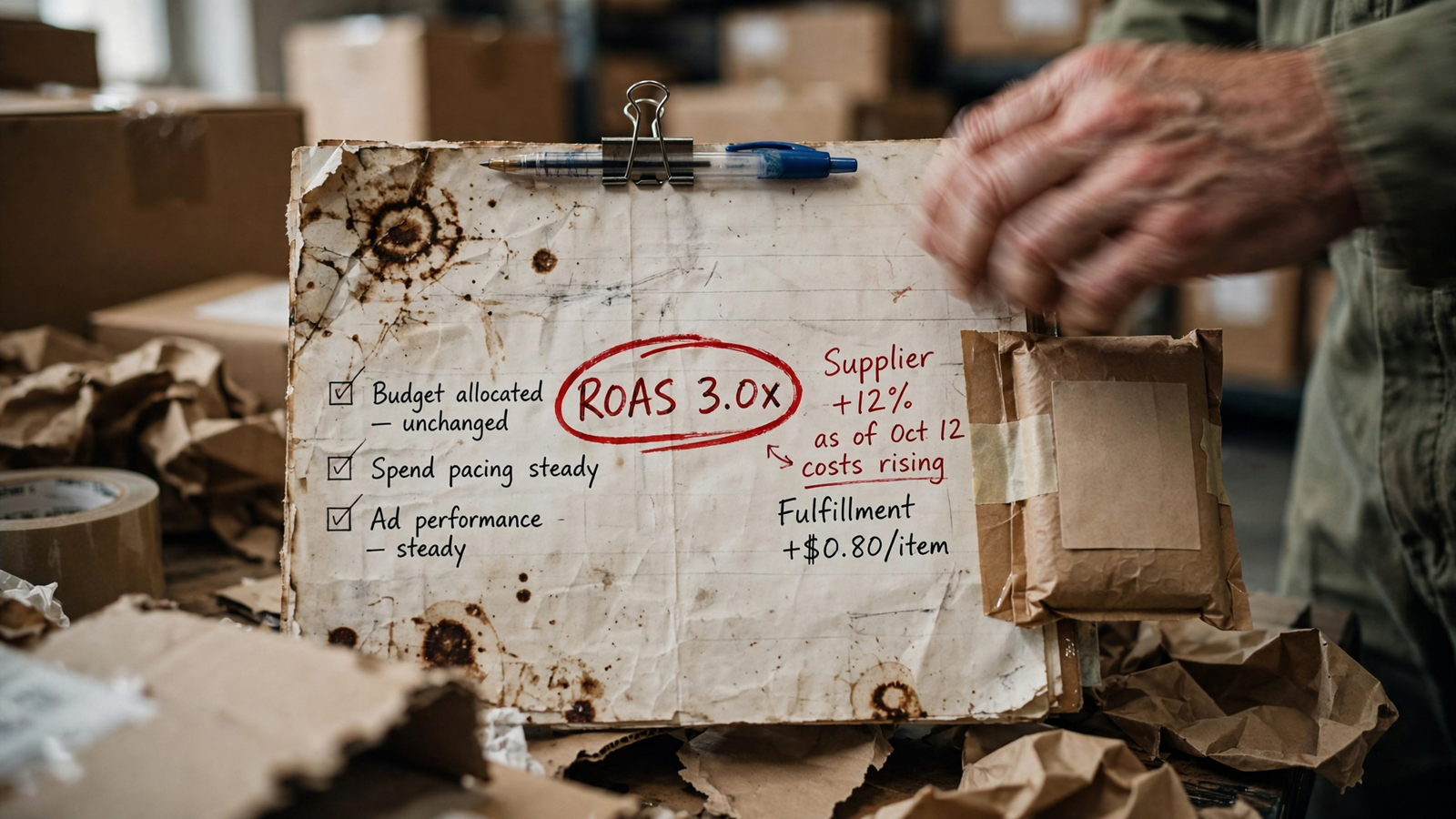
Replace the costs your old target forgot
-
Replace old product costs with current landed costs.
- Pull the latest supplier invoice and record its date beside the landed unit cost used in the profitability sheet.
- Replace the old cost for each SKU you advertise; do not leave last quarter’s number in place because the reporting template already contains it.
- Check the products inside bundles as well as individual listings, so the bundle calculation reflects the costs of what actually ships.
- Flag the SKUs whose costs changed most; those are the first products to revisit when deciding what deserves more spend.
- Give one person ownership of the cost sheet and put a date beside the update; “finance has the latest version” is not a usable input.
- Keep the current cost visible beside the old one so the person buying traffic can see why an approved target needs replacing.
- Common miss: the P&L uses last quarter’s costs while Meta buys traffic at this week’s prices. Fix the input before judging the buyer.
-
Deduct the variable costs of fulfilling and collecting each order.
- Start with revenue, subtract product cost, fulfilment, payment and platform fees, and other per-order variable costs, then divide the remainder by revenue.
- Label the result pre-ad contribution margin: the share of revenue left to pay for advertising before fixed costs enter the picture.
- Include pick-and-pack charges and current postage costs rather than stopping at the difference between selling price and product cost.
- Use the payment and platform charges that apply to the order; do not borrow a headline fee and assume it covers everything.
- Record each deduction separately so a shipping increase does not disappear inside a margin percentage nobody can explain on the budget call.
- Keep fixed management fees below this calculation; they still matter to profit, but they are not a per-order fulfilment cost.
- Common miss: headline gross margin stands in for contribution before advertising. The missing costs do not disappear because the spreadsheet stops early.
-
Match discounts, refunds and return costs to the revenue you keep.
- Use net revenue after discounts and expected refunds rather than treating the checkout subtotal as money the business permanently keeps.
- Put the expected refund and return rate on the sign-off sheet, alongside the cost inputs, rather than leaving it in a separate report.
- Check whether the advertised SKU or bundle carries a different return burden from the store average before assigning it the same economics.
- Match the revenue and cost assumptions to the same set of orders; do not assume every sale sticks while every return costs nothing.
- Keep return-related costs visible in the contribution calculation rather than letting them emerge later as an unexplained gap against the P&L.
- Check that refunds are not deducted again after they have already reduced the revenue used to calculate contribution.
- Common miss: the revenue line assumes perfect retention and the cost line assumes perfect fulfilment. Neither describes the orders the store actually keeps.
Set the threshold before choosing what to scale
-
Recalculate break-even ROAS from the new contribution margin.
- Calculate break-even ROAS as 1 divided by pre-ad contribution margin, using the margin rate as a decimal rather than a whole percentage.
- Put the old and new thresholds side by side: a move from 40% margin to 30% moves break-even from 2.5x to approximately 3.33x.
- Mark what that means for the existing target: 3.0x clears the first threshold and misses the second, even if Ads Manager stays green.
- Label this number advertising break-even, not the final profit target; fixed management fees and other fixed costs still sit below contribution.
- Do not fold a fixed fee into the per-order margin merely to make the sheet produce the answer someone already approved.
- Record the new threshold, its underlying margin, the approval date and the person signing it off before reopening the scaling conversation.
- Common miss: “We agreed on 3.0 last quarter” passes for a commercial argument. An old approval does not pay a new supplier invoice.
-
Rank products by what they now contribute, not what they used to sell.
- List advertised SKUs and bundles by their current contribution per order, using the updated product, fulfilment, discount and return assumptions.
- Flag which products moved most after the cost increase so the campaign review starts with the economics that changed.
- Check each product against the break-even threshold its own margin supports rather than assuming the store-wide average makes every order equally scalable.
- Push spend toward lines that still clear their updated threshold; cap the lines that no longer do before asking for more overall budget.
- Review bundles as bundles: an offer can keep its familiar selling price while the products and delivery inside it absorb the contribution.
- Put the product-level decision beside the calculation so the next buyer sees whether the instruction is to maintain, cap or increase spend.
- Common miss: a familiar bestseller gets a permanent exemption. Sales volume is not permission to scale an order that no longer pays its way.
Make the reported revenue match the margin calculation
-
Document exactly what Meta’s purchase value contains.
- Check whether the pixel and Conversions API send product subtotal or grand total; write down the actual setup rather than assuming a default.
- Record whether that value includes shipping and tax, and whether refunds change the value against which campaign performance is being judged.
- Record the attribution window in use, including whether the report uses a 7-day click plus 1-day view window.
- Check the difference between Meta purchase value and Shopify net sales before treating the two reports as interchangeable revenue figures.
- Compare ROAS with a threshold built on the same revenue basis; net product contribution cannot be judged against a checkout value without reconciling the difference.
- Keep that definition beside the target on the sign-off sheet so a change in reporting does not masquerade as a change in profitability.
- Common miss: the margin calculation removes tax, shipping and refunds while the reported ROAS still includes them. The arithmetic works; the comparison does not.
-
Separate new-customer economics from repeat purchases.
- Split first-order contribution from repeat-purchase contribution so the account’s blended result does not hide what acquiring a new customer actually costs.
- Assess acquisition cost against margin rather than revenue; revenue alone hides the cutoff at which an order stops funding its acquisition.
- Write down whether a first-order loss is acceptable, how it is funded and the payback rule the business can actually support.
- Do not fund an unaffordable first order with assumed lifetime value; a repeat purchase that has not happened cannot pay today’s advertising bill.
- Show the new-versus-repeat split alongside campaign results before using blended ROAS as permission to expand prospecting spend.
- Keep the payback rule on the same approval page as the budget cap, rather than allowing a different explanation on every call.
- Common miss: repeat buyers make the account look healthy while prospecting buys orders that never pay back inside a fundable window. Separate them before approving growth.
Remove stale promises and stop automatic budget increases
-
Check every live offer against the costs the store now carries.
- Open each active ad and its landing page, then check the shipping and returns pages rather than reviewing the creative in isolation.
- Check every advertised price, discount threshold, delivery promise and “free returns” claim against the updated cost sheet and current offer.
- Remove or correct promises the cost change has made unsustainable; a working ad is not a reason to preserve an unworkable offer.
- Assign one owner and one completion date to each correction so the media buyer and brand team cannot leave it between them.
- Check the ad and destination together after the change; fixing one side leaves the customer seeing two versions of the same offer.
- Record the correction beside the affected campaign so the next performance review accounts for what the customer was actually promised.
- Common miss: the buyer calls creative “brand’s job,” brand says nobody mentioned the cost increase, and the old offer keeps spending while ownership gets discussed.
-
Reset budget caps, approval rights and escalation rules in writing.
- Record who can increase daily budgets, by how much and on what evidence; name an approver rather than assigning the decision to “the team.”
- Keep prospecting at its current daily cap until the updated margin, comparable revenue measure and new break-even threshold have been signed off.
- For the illustrative $20k-a-month account, write an explicit rule: allow a 20% increase only after seven days above the new threshold using the agreed revenue basis.
- Add the stop rule: pause scaling and trigger a review if refunds push kept-revenue ROAS below break-even for two consecutive weekly reads.
- Put these example guardrails through the same sign-off as the target; they are not permission to scale before checking the underlying contribution.
- Keep caps and escalation rules in the budget sheet, not scattered across Slack messages that the next person raising spend may never see.
- Common miss: “scale the winner” still means beating the dead 3.0 target. Replace the instruction, not just the number in the report.
Demand the explanation that connects buying to profit
- Require a weekly commercial explanation, not another ROAS report.
- Ask whoever runs the account for one page showing spend, net kept revenue after discounts and refunds, and contribution after current product and fulfilment costs.
- Include the new-versus-repeat split and the agreed payback rule so the report cannot hide weak acquisition behind profitable repeat orders.
- Require each campaign change to connect to those lines: what changed, why it changed and whether the resulting orders remain worth buying.
- Check whether a higher reported ROAS reflects better economics or a 7-day click plus 1-day view window crediting orders another channel would have closed anyway.
- Use the same test when a lower-return product looks efficient in Meta: check its contribution rather than assuming fewer returns make it profitable.
- Send the sign-off sheet before the call; expect questions about SKU margins, return assumptions, shipping in purchase value and the split between new and repeat buyers.
- Treat a discussion of broader audiences, fresh hooks or Advantage+ placements as incomplete until the manager explains which orders the business can afford to buy.
- If the connection remains missing, use groas’s checklist for whether a reported ROAS increase reflects additional orders before approving another increase.
- When replacing a provider, use these tests for Meta agencies on margins, returns and new-customer economics rather than accepting a promise to improve the dashboard.
- Keep increases paused until someone can show kept-revenue ROAS against the updated threshold and explain the campaign decisions made because of it.
- Run the cost check: $20k of spend at 3.0 ROAS produces $60k of revenue; if that is net kept revenue at a 30% pre-ad margin, it leaves $18k before ads.
- Subtract the $20k advertising bill: the account is $2k short before fixed fees, despite hitting target; do not deduct refunds again if net kept revenue already excludes them.
- This is the most-skipped item, and skipping it lets efficient-looking losses earn a bigger budget. Make the awkward call, rebuild the threshold, and only then talk about growth.


