

 LinkedIn

A falling ROAS number is not a creative diagnosis
The last Meta automation tool I’d buy is the one that pauses a losing ad fastest. If it can’t tell me whether the ad got worse or the conversions just haven’t come in yet, I’ve paid to act on a guess sooner.
An advertiser who said he was losing $300 a day got the usual pair of answers: spend more or change the creative. The thread is worth reading because both answers skip the same step. Neither tells him what actually changed in the account. One asks him to spend more before he knows. The other asks him to replace an ad before he knows. Neither is a diagnosis.
ROAS can fall because the creative is wearing out. It can also fall because conversions are landing a day later, Meta has shifted delivery to a different placement, an attribution setting has changed what counts, or the account has too few purchases to draw a conclusion. The dashboard can show the same drop in each case. The right response isn’t the same.
Take the advice to change the creative. If the latest conversions just haven’t come in, the original ad hasn’t failed the test. The report hasn’t finished counting it. Swap the ad now and I’ve made a creative decision without knowing whether I had a creative problem.
That’s why I’d rather connect Claude through groas and make it argue against its first conclusion than buy a faster version of a rule I wrote on a bad afternoon. A drop is a reason to investigate, not an instruction to pause.
Make Claude argue against the pause
My first prompt is deliberately narrow: “Read this Meta account’s results. Separate observed changes from possible causes. Make no changes.” I want campaign, ad set, and ad results over comparable periods, with spend, conversions, attribution settings, and every placement breakdown Claude can get. If it can’t see a field, I want it to name the missing field. There’s a difference between seeing that delivery moved and guessing that people got tired of the video.
Connecting Claude through groas gives it access to the live account over MCP instead of leaving it with a screenshot or a CSV I exported three days ago. That gets the investigation onto the account’s numbers. It doesn’t make the first explanation right. The second prompt does the real work: “What evidence would overturn your creative-fatigue explanation?” I’d make Claude work through the alternatives in this order:
- Check whether there’s enough evidence. Meta recommends judging performance over at least a full week, not by the hour or the day. Short slices bounce around, and learning-phase results are messier still. If an ad set has spent $200 in 48 hours and produced two conversions, “fatigued” is a guess wearing a lab coat.
- Check whether the count changed. Recent conversions can land later. A change from 7-day click to 1-day click can also pull reported ROAS down without the ad getting worse: the counting window got shorter. Meta’s attribution-window comparison is where I’d look before charging the difference to the creative. I want Claude to tell me whether the periods were measured the same way before it tells me which one performed worse.
- Check where the spend went. If more of it moved from Feed to Reels or Audience Network, the ad didn’t change. The room it ran in did. I want Claude to show me whether results got worse within a placement or whether the overall number fell as the mix shifted. If the placement breakdown is missing, delivery is an open question, not a cause Claude has ruled out.
The longer version is in seven checks Claude should run before calling Meta ads fatigued. The point of the short version is to make not enough evidence an acceptable answer. It’s better than pausing an ad because the rule has nowhere else to go.

Only then do I want to hear the case for fatigue. There’s no universal frequency number at which Meta declares an ad fatigued. Meta’s labels compare cost per result with past ads: Creative limited means the cost is above the benchmark but under twice it; Creative fatigue means it’s at least twice the benchmark. The test applies to single-creative ad sets and counts recent exposures even from other campaigns run by the same Page.
Meta’s suggested fix is to create a materially different ad. It also says keeping the original active rather than pausing it can maximize results. That’s the bit I’d put next to any pitch for an instant pause rule. A tool that calls fatigue at frequency 3.0 because a blog post said so isn’t following Meta. It’s following a template.
Buy for the question the workflow can answer
I’d start with Meta itself. Advantage+ handles audience, placements, and budget allocation inside the auction. It optimizes toward the signal I give it; it doesn’t stop to ask whether a drop in reported ROAS reflects a worse ad, a shorter counting window, or two conversions doing all the work in my report. It answers How should I deliver this campaign? I wouldn’t buy it to answer Why did this ad stop working?
A dedicated Meta tool can take the next step. Madgicx describes a stack that uses Advantage+ for delivery, automated rules checked at least every 30 minutes, and an AI layer that can propose actions for approval, including pausing or duplicating ads and changing budgets. The issue isn’t whether it can act. It’s what a rule knows when it fires. Someone still has to choose the target ROAS and the window over which to judge it. Set that rule against a 1-day click window with thin conversion volume and it can do exactly what I asked for the wrong reason. A rule can enforce a threshold. Hitting the threshold doesn’t explain the drop.

Claude connected through groas is what I’d buy for the third question: What evidence supports this conclusion, and what would change it? I can ask it to show me the attribution comparison and placement breakdown, then make it explain why either one does or doesn’t account for the drop. It also has competitor ads and Reddit threads to draw on when I want context for the next creative brief. Those don’t tell me why my ROAS fell. The account evidence has to do that work.
I’d rather wait ten minutes for a diagnosis I can defend than save nine minutes pausing the wrong ad. If I ran one campaign at $20 a day and liked doing the checks myself, I wouldn’t bother adding a Claude workflow. Give me multiple accounts, thin conversion volume, and rules that would otherwise fire on noise, and I want the workflow that makes the case before it makes the change.
Give the replacement ad one job
Even when the evidence points to creative, “make a new ad” isn’t a brief. If click-through fell while cost per landing page view held, I’d test the hook or thumbnail before paying to reshoot the whole thing. If outbound clicks held but add-to-carts fell, I’d look at the landing page or the offer before blaming the video. In both cases, I want Claude to tell me which part of the problem the new ad is meant to fix.
Name the change, the audience, and the metric that would show it worked. I’d keep the ad set and budget the same and make one material change to the creative. If the brief is to recover click-through, I’d change the opening scene and judge it on click-through. A new opening scene gives me something to test. A new opening scene, a different offer, and a budget change give me a result I can argue about.
Competitor ads can help with the brief, not the verdict. groas gives Claude the ads and the funnels behind them, so I can ask it to compare hooks, angles, and offers before it drafts anything. I don’t want it to copy a rival’s headline and call that a test. Seeing an ad in the library doesn’t tell me the competitor’s margin, attribution window, or whether they’re losing money more slowly than I am.
One 2026 analysis of 368 Meta ads across 15 DTC brands found that 80% never reached 100,000 lifetime impressions. That isn’t a threshold I’d turn into another rule. What I’d keep from the analysis is the split between four explanations: creative failure, creative fatigue, auction pressure, and funnel or measurement failure. An ad that never worked and an ad that’s stopped working don’t give me the same brief.
Practitioner guidance on replacing fatigued creative lines up with Meta’s advice: add something materially different rather than killing the original first. Change the opening scene, the presenter, the format, or the promise. If the only difference is the font weight, I haven’t replaced the ad. I’ve redecorated.
Put approval between diagnosis and execution
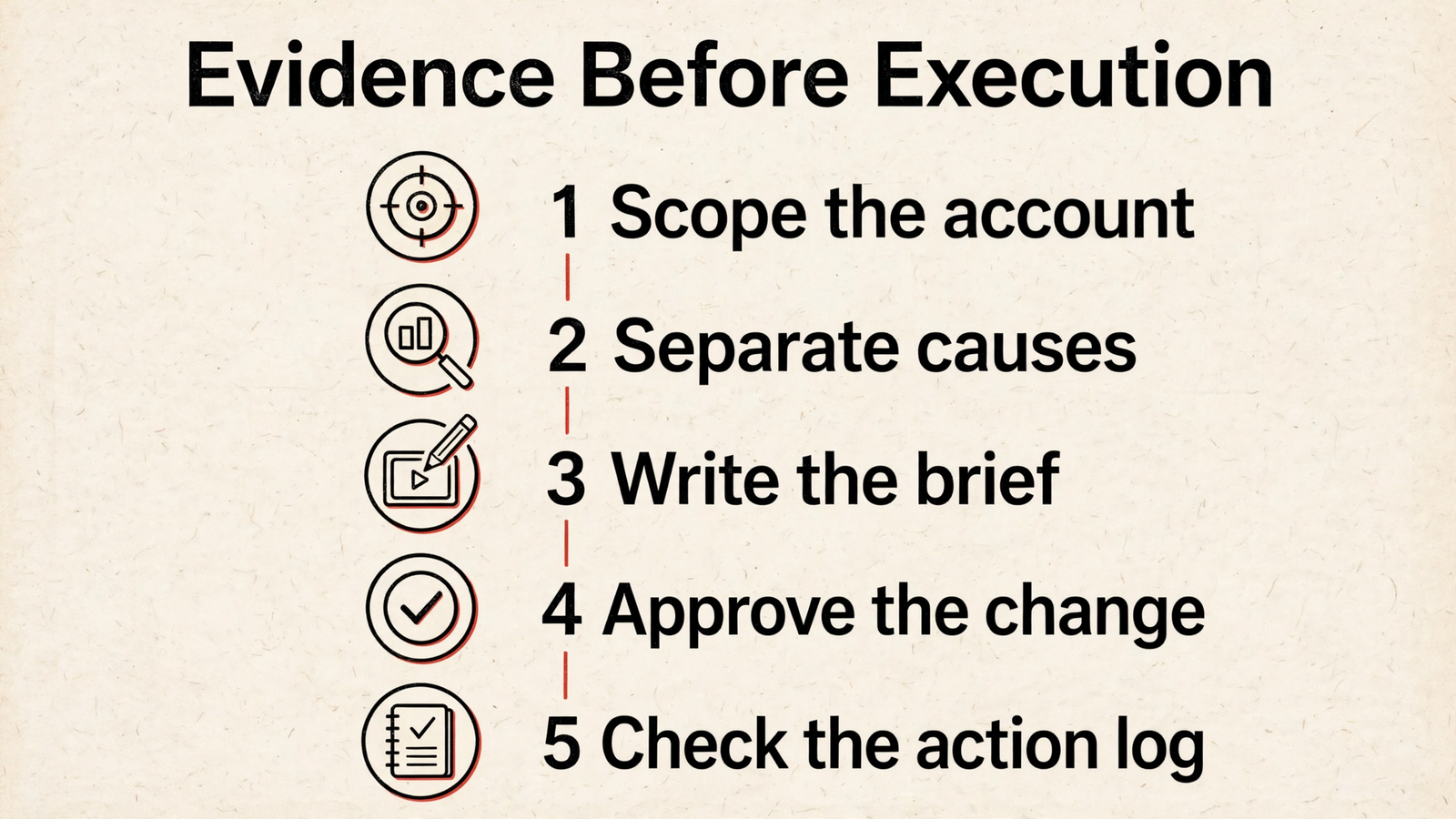
Here’s what I’d write into any Meta workflow I buy, manual or automated: No pause without a reason I can check. I want the account scope, the evidence, and the proposed action in the same place, so I don’t have to reconstruct the argument after the ad is already off. “ROAS below target” tells me why the rule fired. It doesn’t tell me why I should approve the pause.
- Set the scope. Name the campaigns, dates, and attribution setting before anyone touches a switch.
- Show the evidence. Separate what changed from what might explain it, and name the data Claude couldn’t see.
- Propose the action. Identify the exact ad and attach the reason for pausing it. If the evidence doesn’t support a pause, say so.
- Get approval. I’d keep approval on every change until the diagnosis had earned my trust.
- Check the log. Match the action that ran to the action I approved.
With groas, autopilot stays off until I switch it on. I can have Claude propose changes for me to approve, and each change is logged with its reason. That log isn’t paperwork. It’s how I check that the ad that paused is the one Claude actually made a case for.
If the wrong ad paused, I have a process problem, not a performance problem. groas can undo its own action in one step, but Meta limits what can be restored. A paused ad or a changed setting may not return to exactly its prior state. That’s another reason to put approval before execution instead of treating undo as the approval step in reverse.
groas Unlimited costs $19 a month flat, with unlimited teammates, ad accounts, and websites, every feature included, and the option to cancel any time. I’m not paying per account to ask my own AI why ROAS fell. The cost I’m willing to pay is the few minutes it takes to check the evidence before the rule gets to act.
Buy the diagnosis first. If the ad really needs to go, the pause button will still be there. Buy for speed and the next time conversions come in late, the tool can shut off an ad that was still working before you’ve even looked at the count.





