

 LinkedIn

Free SEO is only free if someone does the work. If you own a business and have no time to manage it, your choice is Google Search Console plus your own AI, with you doing the shipping, or groas Unlimited at $19 a month flat, giving that AI more data and the hands to change your site.
I like free tools when free is enough. Search Console plus the AI you already use covers a lot: real queries, real clicks, real indexing problems, and help making sense of them. What it does not supply is competitor and backlink research, visibility into AI answers, or a way for that AI to implement its recommendations. groas adds competitor, Reddit, AI-answer and Semrush/Ahrefs data, plus the connection between a recommendation and a live change.
The decision is not whether free reports are useful. It is whether you can act on them. If you can, start free. If you cannot, another report will not solve the problem.
The comparison: four decisions that matter to a busy owner
I am scoring this for an owner with no spare hours to manage SEO. Not a hobby blogger. Not an in-house team with a content calendar. I mean the person who needs a buyer question turned into a published page and a technical problem moved out of the inbox.
Search Console provides free first-party data about your Google performance: queries, clicks, impressions, average position, indexing, Core Web Vitals and manual actions. That is a useful foundation. It is not a picture of the whole market, and it does not make changes to your website.
| What you decide on | Free: Search Console + your AI | $19: groas + your AI |
|---|---|---|
| Turning buyer questions into pages | Your AI helps with analysis and drafts; you collect extra research and publish | Your AI works from competitor, Reddit and Semrush/Ahrefs data and can publish through your connected site |
| Acting on problems | You implement the recommendation or find someone who can | Your AI can make site changes within the access and rules you give it |
| Measuring beyond Google | Search Console reports your Google performance | Adds AI-answer visibility, citations and competitive context |
| Cost and workload | Search Console is free; research and implementation still take your time | $19 flat for unlimited teammates, ad accounts and websites; you still set direction and permissions |
My bias is simple. I trust free measurement. I do not budget as though implementation happens by itself. A small-business SEO plan can call for 2 to 4 hours a week, with content time on top. That is not a rounding error when you also run the business.
For this reader, the winner must help get the work live. A better-looking backlog is still a backlog.
Round 1: Who turns a buyer question into a published page?
Search Console shows the queries your site already appears for. That makes it useful for improving existing visibility: you can give your AI the query data and ask what deserves attention. But that data cannot show every buyer question you are missing. Your site has to appear before a query can appear in your report.
Your own AI can help investigate beyond that boundary. Feed it competitor pages and Reddit discussions, and it can help identify questions worth answering. The free route is not short of possibilities. It is short of someone doing the collection, checking the draft and putting the page on the site.
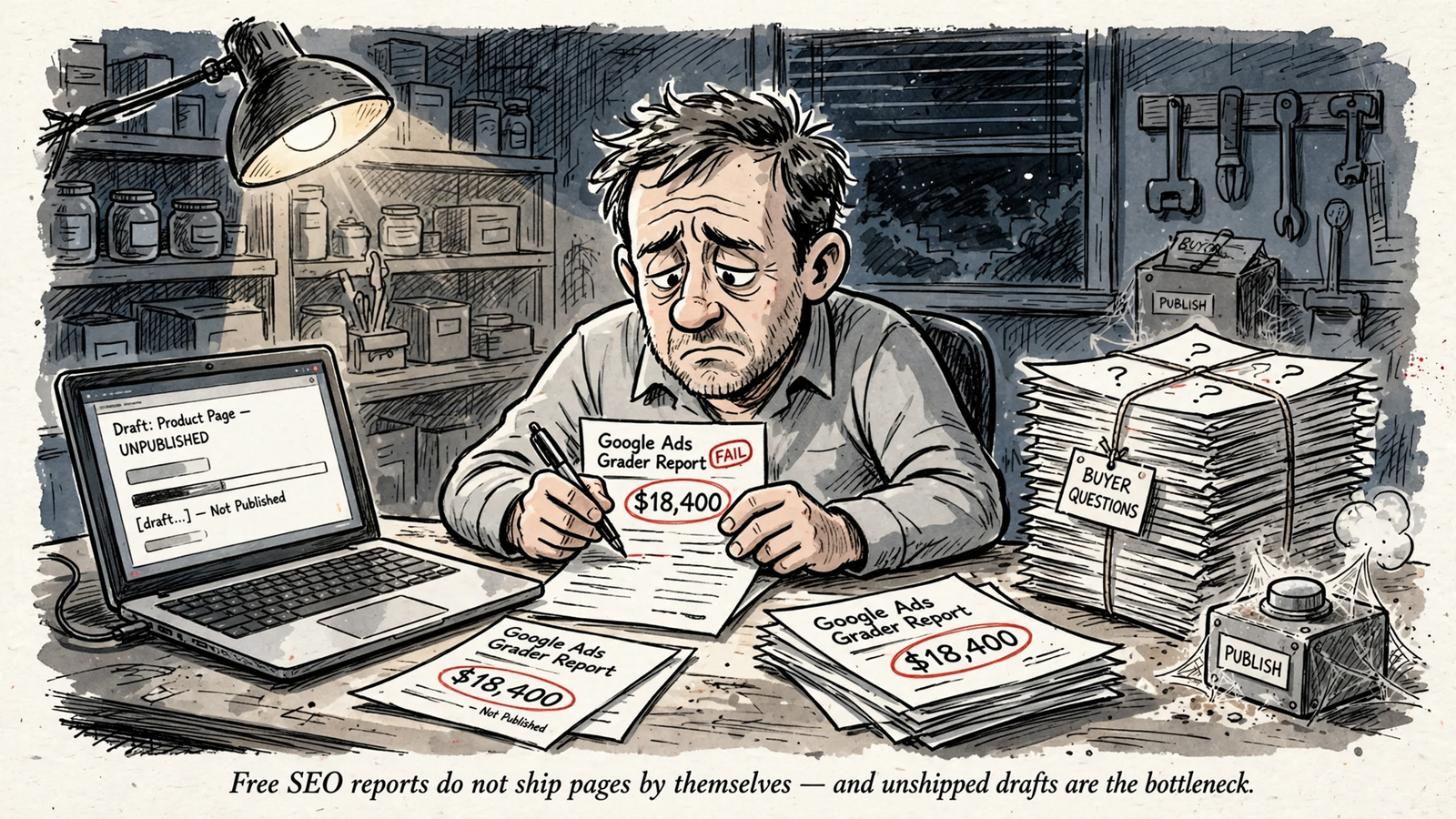
That distinction gets lost in tool comparisons. “AI can write it” quietly becomes “the page is published.” There are several jobs between those two sentences, and on the free stack they still belong to you.
Free gives you a useful starting point. It does not give you a live page.
With groas, your AI can work from data you do not have to collect by hand. groas watches competitor ads and the landing pages and funnels behind them, what customers say on Reddit, and how AI answers talk about you and whom they cite. Semrush and Ahrefs data adds keyword and backlink context.
Ask your AI, in plain English, to identify the buyer questions you are missing. It can draft from that pool and push a change to your connected site within the rules you set. Instead of handing you another document to paste somewhere later, it has a route to implementation.
You still decide whether the proposed page belongs on your website. More data does not remove that decision. It removes some of the research and publishing work around it.
I used to tell clients to write one buyer page a week. The instruction sounded practical. It also assumed they had someone available to do it. Ideas were rarely the hard part. Shipping was.
My call for round one: stay free if you can reliably turn research into published pages. If drafts keep accumulating, buy the ability to ship, not another source of ideas.
Round 2: Who acts after the report finds a problem?
Search Console is a good doctor with no hands. It can flag indexing problems, Core Web Vitals issues and manual actions. Then someone has to investigate what happened, decide what to change and make the change.
On the free stack, that someone is you or a person you coordinate. Your AI can help interpret the report and suggest a next step. But an explanation in a chat window is not an edit to your website.
The implementation chain looks like this:
- Read the report and identify the problem.
- Decide which recommendation makes sense.
- Get the access or help needed to act.
- Make the change.
- Check what happens afterward.
None of those steps is glamorous. All of them matter. A correct diagnosis stuck at step three does not improve the site.
If you run the free stack, you own the ticket queue. That can work perfectly well when you have the access, confidence and time. It works less well when every fix requires another email.
With groas, you connect your website and add groas to your AI over MCP or with an API key. Your AI can then act through that connection rather than stopping at instructions. The permissions and rules you set define what it can do.
The controls matter as much as the connection:
- Autopilot stays off until you switch it on. Connecting the tools is not an instruction to run everything unattended.
- Every change is logged with its reason.
- Any change can be undone in one step.
That is a different proposition from receiving a longer audit. The AI can move from identifying an issue to making a permitted site change, with a record of what it did and why.
I would not confuse that with a promise that every technical problem fixes itself. Access and scope still matter. The point is narrower and more useful: when your AI can make the required change, you do not have to become the messenger between the recommendation and the website.
My call for round two: free is fine if you clear the queue. If recommendations keep dying in your inbox, groas addresses the part of the process that another diagnosis cannot.
Round 3: Can you see beyond your own Google results?
Search Console answers an important question: how is your site performing in Google? It does not answer a different one: what does ChatGPT say about your business, and whose pages does it cite?
Those questions deserve separate attention. Your Google clicks can tell you something useful without telling you whether an AI answer names your brand. And a report about your own site cannot, by itself, explain the competitor pages and conversations shaping the rest of the market.
Google performance is not ChatGPT visibility. I would keep Search Console for the job it does well rather than stretch it into a report it was never meant to be.
Your own AI can help with broader research, but you still need to supply the material or collect it manually. You can inspect answers, gather competitor pages and bring the results into a conversation. You then have to repeat the exercise if you want to know what changed.
That is why I judge these products by who does the work after the chart, not just by who draws it. A snapshot is useful. Maintaining the picture is another job.
With groas, your AI gets data about how AI answers discuss your business and whom they cite, alongside competitor, Reddit and Semrush/Ahrefs context. That gives it more to work with than your own Google query history alone.
The practical difference is the question you can ask. Instead of stopping at “Which of my pages lost clicks?”, you can also investigate:
- What do AI answers say about my business?
- Which sources do those answers cite?
- What are competitors putting in their ads and landing pages?
- Which buyer questions keep appearing on Reddit?
- Where do keyword and backlink gaps deserve attention?
That is a wider research brief, not a ranking guarantee. Neither route can promise you the top spot or a guaranteed AI recommendation. More context helps you choose what to work on; it does not give you control over the answer someone else displays.
My call for round three: free is enough when Google performance is the question you need answered. For a time-poor owner who also needs competitor and AI-answer visibility, groas covers the missing ground without making manual collection another weekly task.
Round 4: What does “free” cost when you have no time?
I count hours here, not an imaginary hourly rate designed to make a subscription look cheap. If you have the time and like the work, Search Console plus your existing AI is a sensible place to stay. You get useful Google data, and your AI can help analyse whatever you provide.
But the work still needs a place in the week. Research, content, implementation and follow-up do not disappear because the reporting tool costs $0. A plan built around 2 to 4 hours a week plus content time is a real commitment.
For an owner who cannot make that commitment, the problem is not the quality of the free tool. It is the gap between knowing and doing. Pages stay in drafts. Fixes stay in email. The following month brings another report about much the same site.
A $0 tool does not make the work take zero hours. That is the cost worth comparing.
groas Unlimited costs $19 a month flat for unlimited teammates, ad accounts and websites, every feature and all the data. You plug it into the AI you already use rather than replacing that AI with another dashboard you have to learn to operate.
What you buy falls into two parts:
- The data: competitor ads and funnels, Reddit conversations, AI-answer visibility, and Semrush/Ahrefs keyword and backlink context.
- The ability to act: a connection through which your AI can make changes to your site and ad accounts, subject to your permissions and rules.
I would keep that distinction clear. The $19 plan is infrastructure for your AI, not a senior team taking over your marketing. You still choose the direction, grant access and decide what can run unattended. Nor does the subscription replace your domain, hosting or ad spend.
The reason it wins for this reader is not that all responsibility disappears. It is that the research and implementation no longer have to stop at your keyboard.
My call for round four: keep the $19 if you already do the work. If lack of time is what prevents the work, the free stack leaves your main constraint untouched.
Verdict: stay free if you ship, pay $19 if you don’t
For the business owner with no time to manage SEO, groas plus your own AI wins. Search Console tells you what happened to your site in Google. It does not supply the competitor, backlink and AI-answer picture, and it does not put the recommended change live.
groas adds that data and the means for your AI to act on it under rules you set. That is the case for paying $19: not a prettier report, not a guaranteed ranking, and not an agency hiding inside a cheap subscription. It connects useful research to work that can actually reach your website.
If execution is your constraint, execution is what you should buy.
Pick the loser anyway if you are the exception. If you can publish one buyer page a week, review indexing problems monthly and implement the changes that matter, stay on Search Console plus your AI. Keep the $19. Before paying anyone, check who actually ships the work in the tool versus agency versus done-for-you comparison.
I mean that. Free is enough when labor is not the problem. For everyone else, stop collecting another month of accurate reports about work that never shipped.


