

 LinkedIn

Google Search spot-checks and groas tracking read through Claude answer different questions. If you are choosing an AI Overview tool because a competitor appeared in an answer and you want to know how often that happens, buy the repeatable record, not the screenshot.
That is my verdict up front. One screenshot proves what appeared in one observed answer, not how visible your brand is across a market. Manual checks earn their place when you need to inspect an answer and the page behind it. Connected tracking wins when you need to measure a pattern across a defined set of buyer questions.
The choice comes down to four things: what you can inspect, what you can repeat, what the numbers mean, and how much work the routine creates.
1. Answer inspection: manual Google checks earn their place
For a manual pass, I start with 10 to 20 real buyer questions. Not a sprawling keyword export. A short list of questions whose answers would matter to a potential customer.
Then I keep the conditions consistent and record what actually appears:
- Fix the country, language and device.
- Run the exact query and record the date.
- Note whether an AI Overview appears.
- Record whether the answer names the brand.
- Save any cited URLs and read the pages behind them.
The important distinction is a mention is not a citation. A mention means the answer names your brand, with or without a link. A citation carries a link that can send a click. An unlinked mention may shape perception, but it does not give the reader that route to your site.
This is where a manual check is useful. I can read the sentence around a citation, open the source page and judge whether the answer helps the brand or merely names it. A dashboard rate cannot make that judgment for me. Neither can a screenshot cropped tightly enough to hide the awkward sentence underneath.
The weakness is repetition. Answers change, and presence and content can vary by query, location, device and other conditions. One observation gives me something concrete to inspect. It does not give me coverage or a trend.
Logging out is not enough to make the check a control, either. Incognito strips cookies; it does not remove IP location, experiment buckets or data-center variation. If I want to compare runs, I keep country, city, language and device consistent first.
Use the manual check to understand an answer, not to declare a visibility rate.
2. Repeatability: groas gives Claude a record to read
With groas plugged into Claude, the job changes from collecting screenshots to querying records. groas tracks questions on a schedule and stores answer text, cited URLs and observation dates. Claude becomes the way I interrogate that history, rather than another place to paste screenshots.
My opening prompt is deliberately unglamorous:
Show the tracked Google AI Overview questions, observation dates, answers and cited URLs. Flag missing observations.
That last sentence matters. A missing observation is not the same as an observed answer without my brand. It is also not the same as a completed check where no AI Overview appeared. Before I ask Claude for a trend, I want to know whether the record is complete enough to describe one.
The stored history lets me ask questions a one-off check cannot answer: On which dates did the brand appear? Which URLs received citations? Did the same rival keep showing up? Did the pattern persist after a page edit?
I still read individual answers. Tracking does not replace that work; it tells me where to spend it. A summary can flag a repeated loss, then I can open the underlying answer and cited page instead of manually refreshing every question on the list.
That matters because citations churn. A 20-day study of roughly 37,500 citations found half of AI Overview citations gone by day two. The practical response is not to celebrate one appearance or panic over one absence. It is to watch whether the appearance repeats.
I prefer looking at days cited over the last 7 days to judging one check. It keeps the question concrete: did this page keep earning a citation, or did I happen to catch its brief moment on screen?
For repeated measurement, groas in Claude wins. Keep the manual read as the inspection layer.
3. Measurement: the denominator decides what the result means
A stored record is only useful if I ask it a coherent question. “How visible are we?” is not one. It leaves the question set, competitor list, engine and denominator open to interpretation.
Start with two measures that are easy to confuse:
- Share of voice: the brand’s mentions divided by total mentions across all tracked brands.
- Visibility rate: answers mentioning the brand divided by all tracked answers.
The share-of-voice example from Searchable makes the distinction clear: 20 of 80 brand mentions is 25% share of voice, while appearances in 20 of 100 answers is 20% visibility. Those figures describe different things. Neither becomes more useful because a slide calls it AI visibility.
I keep the question set and competitor list fixed, and separate branded from unbranded questions. Mixing “What is our brand?” into a set of category-buying questions changes what the number measures. It does not establish that more buyers are discovering the brand.
Then I force the engine split. Google AI Overviews are not ChatGPT answers. Google AI Mode is not the same surface as AI Overviews, either: one comparison found they cited different sources 87% of the time for the same query. I ask Claude to separate Google AI Overviews, ChatGPT, Perplexity and Gemini before summarizing anything.
Here is how the two routines compare across the actual buying decisions:
| Decision axis | Manual Google Search checks | groas tracking read through Claude |
|---|---|---|
| Inspecting an answer | Read the wording, open the citation and inspect the source page | Find the recorded answer and citation, then inspect the relevant loss |
| Repeating the measurement | Repeat and log each check yourself | Query a dated history across the tracked question set |
| Understanding the numbers | Keep the engine, conditions and denominator consistent yourself | Ask for engine splits, missing observations and separate mention and citation measures |
| Work and cost | No tracking subscription, but the checking and logging remain manual | $19 a month for groas Unlimited; query the connected record in plain English |
| Best fit | A small, occasional inspection job | Recurring measurement against a fixed question set and named rivals |
Two log lines deserve particular attention:
- No AI Overview observed: Google showed no AI Overview for that query on that run.
- Brand absent from an observed Overview: an Overview appeared, but it did not name the brand.
Those are not interchangeable losses. The first records whether Google triggered an Overview. The second records whether the brand appeared inside one. Neither, by itself, proves a competitor received a citation; I need to inspect the answer for that.
Conflate them and a report can suggest that the brand lost visibility when Google simply triggered fewer Overviews that week. What the deck calls “AI visibility decline,” I call mixing two different denominators.
The same discipline applies after an edit. If I change the tracked questions, add branded prompts and pool engines at the same time, a higher rate tells me very little about the page change. The comparison moved underneath it.
Before accepting a trend, I ask Claude to show:
- The questions and engines included.
- The dates covered and any missing observations.
- How often an Overview appeared.
- Brand mentions and linked citations separately.
- The denominator used for each rate.
A tracked sample proves what happened inside that sample. It does not prove visibility across all of Search.
4. Work and cost: pay when checking becomes a recurring job
If I am checking fewer than 20 buyer questions on one engine once a month, I would stay with the spreadsheet. That workload fits in an afternoon, and reading the full answers and source pages is part of the job anyway.
Past that point, the arithmetic gets less charming. Twenty prompts across four engines, run three times a week, means 240 checks and roughly four hours of clicking. Then someone still has to organize the observations and explain what changed.
That is the point where I stop treating manual checking as the free option. There may be no software invoice, but there is still a person refreshing a browser and maintaining a log. Repetitive work does not become strategic because it happens in a spreadsheet.
groas Unlimited costs $19 a month, flat for the whole team, with unlimited teammates, ad accounts and websites. With groas connected to Claude, I can query the record in plain English instead of making the reporting routine another export-and-cleanup job.
The purchase only earns its place if I need that record repeatedly. A one-off question about one citation does not become a tracking project just because software is available. Conversely, a weekly report against named rivals should not depend on whether someone remembered to take the screenshots.
For the buyer searching ai overview tool, groas is the better purchase when the job is recurring measurement. Manual Google checks are the option I would keep for a small, occasional inspection task. That is a narrower job, not an equivalent substitute for the history.
Verdict: buy the record, keep the manual panel
My winner for recurring AI visibility measurement is groas in Claude. It gives me a repeatable record to query across a defined set of questions. Google Search spot-checks remain the right choice for someone inspecting a few answers infrequently, without needing to report a trend.
The next step is not to ask Claude to rewrite the entire site. It is to turn the record into a short inspection list.
My Monday routine is boring on purpose:
- Ask for missing observations first.
- Review days cited over the last 7 days, split by question and engine.
- Find three questions where a rival received a citation and the brand did not.
- Read the rival’s cited passage and the page on our site that should answer the question.
- Draft a focused improvement, then review it before publishing.
The prompt is specific:
Pick the three tracked questions where a rival is cited and we are not. Quote the cited rival passage, name the page on our site that should answer it, and draft one improvement under 80 words. Do not publish.
Nothing publishes without my sign-off. The log shows where to look. The manual read shows what the cited paragraph actually says. The proposed edit is still a guess until later observations show whether the citation pattern changes.
No tracker controls Google’s answers or guarantees a citation. The record does not remove that uncertainty. It makes the uncertainty visible across dates instead of hiding it behind one flattering screenshot.
That is how I would rank a first AI visibility tool by what you can verify: inspect an answer first, establish a tracked sample when the job requires it, then argue about content. For a longer treatment of the measurement problem, read why a single screenshot cannot establish a visibility rate.
One screenshot is evidence of one answer. A dated log lets me calculate a rate. I would not pay for the second until I need it, and I would not pretend the first gives me both.
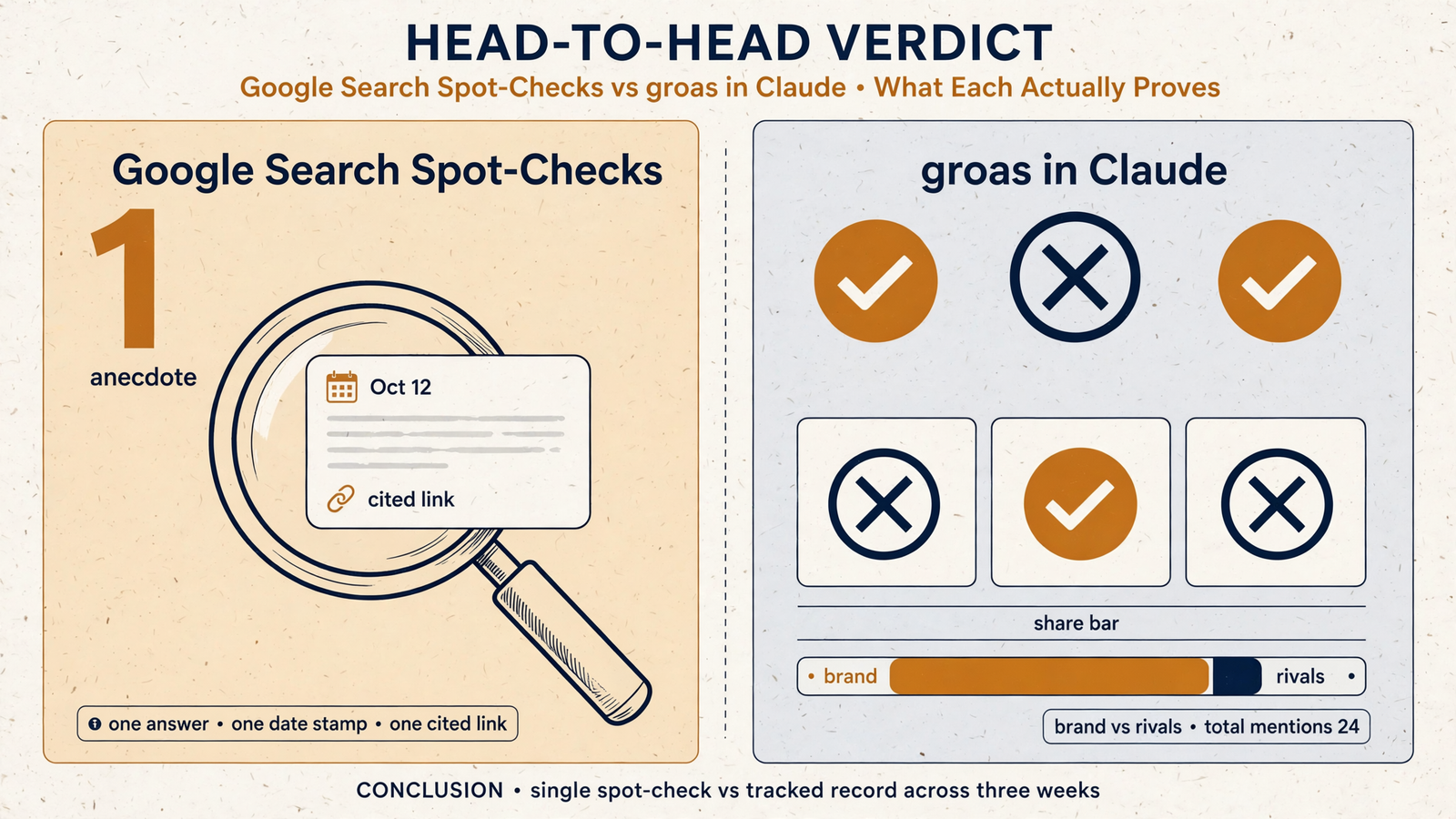
Keep the manual panel even after paying. Tracking shows the pattern across the defined set; reading the source shows what the winner wrote that was worth quoting. When those observations line up for two straight weeks, I have something a screenshot alone cannot give me: evidence of a sustained change in the sample I actually measured.


