

 LinkedIn

Hours saved are a good reason to buy a reporting tool and a bad reason to let ChatGPT manage your ad spend. Cutting four hours of spreadsheet work to twenty minutes is an easy purchase to defend; letting the same assistant move bids, budgets and keywords in a $20k-a-month account is a different purchase altogether.
I used to tell clients to price tools by the hours they gave back. I was wrong. The hours show up first and are easy to count. Ad performance shows up later, and it’s noisy. A faster bad decision still spends real money.
Take a bounded trial to your boss, not a slide multiplying hypothetical hours by salaries. My ask is one account, one kind of change, autopilot off and a named human approving every edit. Measure qualified conversions or revenue, CPA, review time and errors against a baseline. ChatGPT proposes the changes; groas supplies the account access, market data and execution, and logs what changes and why. I’m asking for permission to run a trial, not permission to automate the account.
A faster bad decision still spends money
Reporting assistance and spending authority fail differently. A bad report can send me back to the spreadsheet. A bad bid or budget change can keep spending until somebody notices, and by then I might be two weeks into a CPA drift I can’t explain. That’s the useful distinction in the ChatGPT marketing app market: some tools read accounts; others act on them. Google’s own Google Ads MCP server retrieves account data but doesn’t create, change, pause or enable campaigns. Giving ChatGPT a way to act is the purchase. The prompt isn’t.
I learned this the way most operators do: by watching a small definitional error turn into spend. Even a connected assistant can get marketing math wrong without exact definitions. Spend €100 at 8.0x ROAS and €900 at 2.0x. Divide total revenue by total spend and the account comes in at 2.6x. Average the two ROAS figures and it comes in at 5.0x. Same account, same week, completely different story.
Add mixed currencies or attribution windows and the answer can look like a hallucination when the assistant has simply guessed the formula I never gave it. In a report, I can catch that before I use it. Once the assistant can act, an undefined metric can become the reason for a real edit. I’ll pay for a report that saves time. I won’t hand over a budget on the same evidence.
Price the subscription and the spending decision separately
When I plug ChatGPT into groas, I’m not buying intelligence. I already have that in the chat window I keep open all day. I’m buying a way for it to act on connected accounts, data it can’t see on its own, and a log of what it changes.
Connect once and ChatGPT can read Google Ads, Bing and Meta, along with the market around those accounts: rivals’ ads on Google and Meta, the landing pages and funnels behind them, what customers say on Reddit, how AI answers talk about the brand, and SEO data from Semrush and Ahrefs. Autopilot stays off until I switch it on. If I do, it works inside the rules I set, with changes logged alongside their reasons and reversible in one step.
The subscription price and the money at risk belong on separate lines. I put four numbers on the page:
- Tool cost. Typical ChatGPT ad connectors start free and run about $29.90 to $49 a month on paid plans. groas Unlimited is $19 a month flat for unlimited teammates, accounts and sites.
- Assistant cost. The ChatGPT or Claude plan is separate from the connector.
- Review effort. If an operator spends fifteen minutes a day approving or rejecting proposals, I count those minutes. A human approval step isn’t free because it takes place inside a tool.
- Ad spend. Whether it’s $5k or $40k a month, this is the money the decisions act on. It isn’t a software fee.
The PPC software ROI calculation I still use adds monthly gains from better ads and labor savings, subtracts the software cost, then divides by that cost. Fine for pricing the tool. But I want to see the gains and the labor savings before they’re added together. Otherwise I can make the subscription look like a bargain without showing that the assistant makes a single spending decision worth keeping.
Make ChatGPT put its reasoning on the record
If I ask ChatGPT to summarize performance, it will. Summaries are cheap. Before I approve an edit, I want a record I can audit. No evidence, no edit. I make the assistant write down four things:
- The evidence. Name the account, campaign and date range. Show the search-term or placement data behind the call.
- The proposed change. Specify one edit I can approve or reject. Don’t bundle it with other changes.
- The expected mechanism. Cause first, effect second. Excluding a search term stops spend on those searches. If they’re consuming budget without producing qualified conversions, that’s the reason I’d expect CPA to come down.
- The reason not to act. A thin sample, a seasonal swing or a tracking gap can make a plausible recommendation a bad call. I want the assistant to argue against itself before I have to.
That last part is where I press hardest. A CPA without a conversion definition is a rumor. Am I counting form fills, qualified calls or sales? Which window and attribution model am I using? I make those choices before I hand over the data, not after the answer comes back looking good. That keeps a change in the definition from masquerading as a change in performance.
The proposal tells me what I’m being asked to approve. The groas log tells me what actually changed and why. I want both in front of me when I decide whether the edit was worth making.
Run one trial with the spending limits written down
The question: Does ChatGPT with groas make better decisions on one defined job than my current process? I’d put that in front of a CFO and measure it on account performance first. Typing speed gets its own column.
- Set the scope and the control. Pick one account with enough volume to read and one class of changes. I’d use search-term pruning in a single Google Ads account or retire the kind of stale rules covered in my Black Friday cleanup test. Leave autopilot off. Name the human who approves every edit. Keep a comparison group unchanged where possible. If I switch on round-the-clock execution before I trust the proposals, I’ve skipped the experiment.
- Record the baseline and fix the trial window. Collect four weeks of qualified conversions or revenue where available, CPA, weekly review time and errors caught on review. Use the same conversion definition during the trial. Declare the window in advance and don’t call it early. One incrementality testing example puts the sample at about 80,679 people per group to detect a 10% relative lift from a 2% baseline conversion rate, at 95% confidence and 80% power. That’s not a quota for every trial. It’s a reason not to declare a small lift real after two weeks in one account.
My expectation: review time falls first because the assistant drafts the proposals. CPA moves more slowly, if it moves at all, because the edits have to affect spend and the resulting conversions have to come in. For a low-volume account, I’d run longer or choose an earlier action to measure up front. I wouldn’t rename that action revenue when it’s time to present the result.

- Wait out conversion lag. A conversion-lag breakdown distinguishes the time it takes a conversion to appear in reporting from the time it takes a customer to convert in the first place. A quick reporting update doesn’t make a slow sale close faster. If I grade search-term pruning on day three, I can end up grading the spend before the revenue arrives. I write the lag allowance into the plan: no performance verdict until it clears.
- Write the spending limits and stop conditions before the first edit. Cap daily test spend. Name the CPA increase that pauses the trial. List what ends it outright: broken tracking, undefined conversions or proposals without evidence. ChatGPT proposes, the named operator approves, and groas logs the edit with its reason. Autopilot stays off.
I don’t count undo as a spending limit. Google Ads change history goes back two years, but most native undos only work within 30 days, whole rows revert together, and some changes can’t be undone there at all. Even when a setting is reversible, the budget spent while it was live isn’t. That’s the point of Let ChatGPT Change Your Ads. Undo Is Not a Spending Policy. Put the cap in place before the first change, not after the first rollback.
Give the trial three ways to end
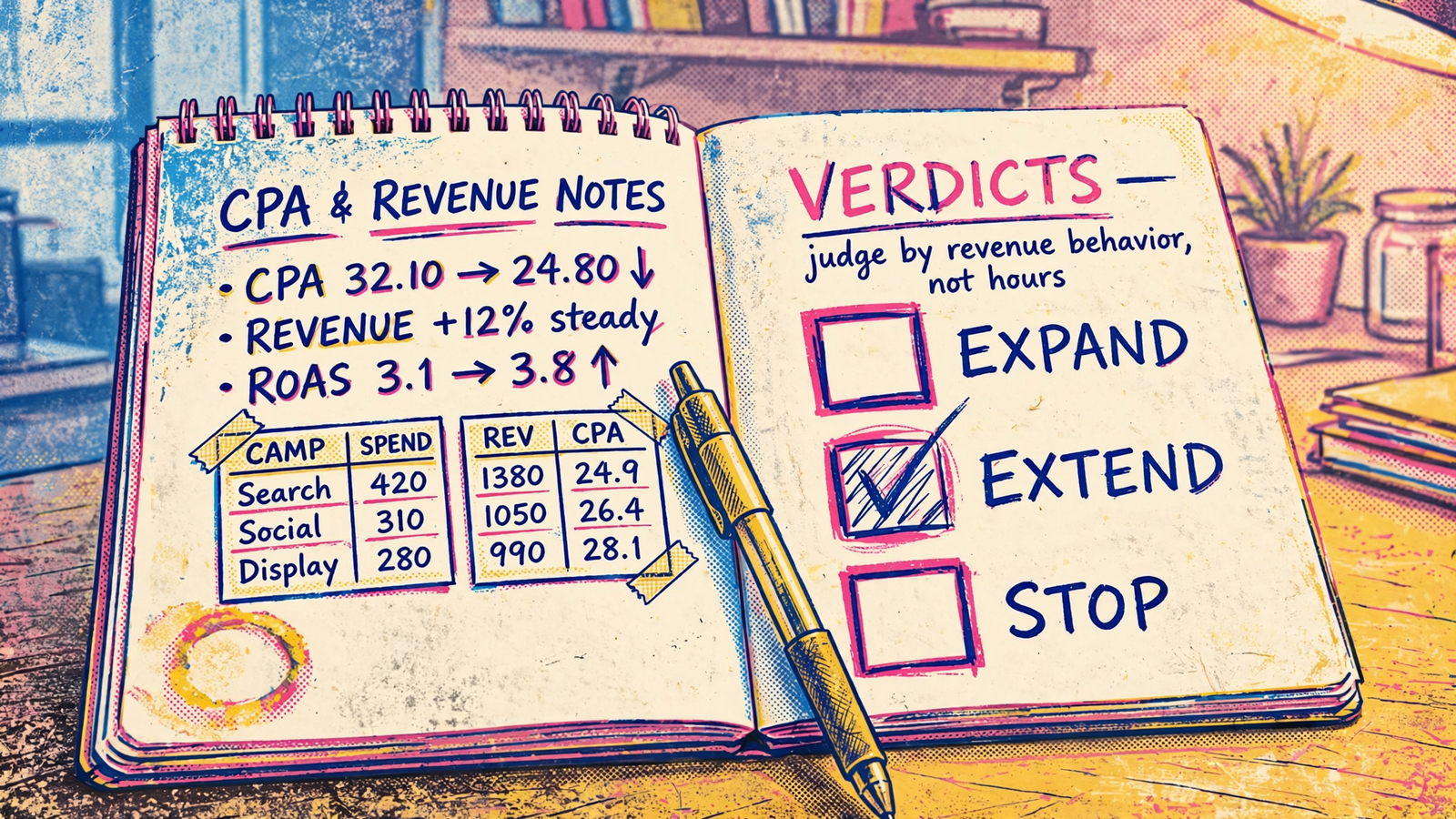
A trial that can only end in purchase is a demo with paperwork. I decide what earns an expansion before I see the numbers. There are three exits:
- Expand. The change class worked, review found no silent errors, and qualified CPA held after the lag window cleared. Widen to a second account or a second change class. Only then consider autopilot under the same spending limits.
- Extend. The result points in the right direction but the sample is thin, the comparison group wobbled or conversions are still coming in. Run longer without widening scope or raising the spending limit.
- Stop. CPA worsened, errors rose, tracking broke or the time it took to review the work cost more than the work gained. Use the log to identify what needs reversing.
This is the part an hours-only case study skips. One Amazon team reported reclaiming more than 1,100 hours across 30 brands. It also reported a 15.5% drop in ad spend while revenue grew and ROAS rose 26%. The hours tell me something about the workload. The spend and revenue tell me something about the advertising. I want both columns filled in before I ask for more authority.
Ask for a trial, not permission to automate growth
Here’s the approval request I’d sign: We pay $19 a month for groas Unlimited alongside our existing ChatGPT plan. We connect one account and test one kind of change for a fixed window. Autopilot stays off. A named operator approves each edit. We track qualified conversions or revenue, CPA after the lag clears, review minutes and errors against our baseline and, where possible, an unchanged comparison group.
If the performance earns it, we expand. If we can’t read the result, we extend without widening the trial. If it loses, we stop, and the log shows which edits we need to reverse. That’s an approval request I can defend because it spells out what we’re putting at risk and what we need to see before we put more at risk.
Spending authority gets earned in the log, not granted in a deck. Keep selling hours saved as the reason to hand an assistant your budget and you’ll get what that slide deserves: a faster way to make bad decisions at scale.





