

 LinkedIn

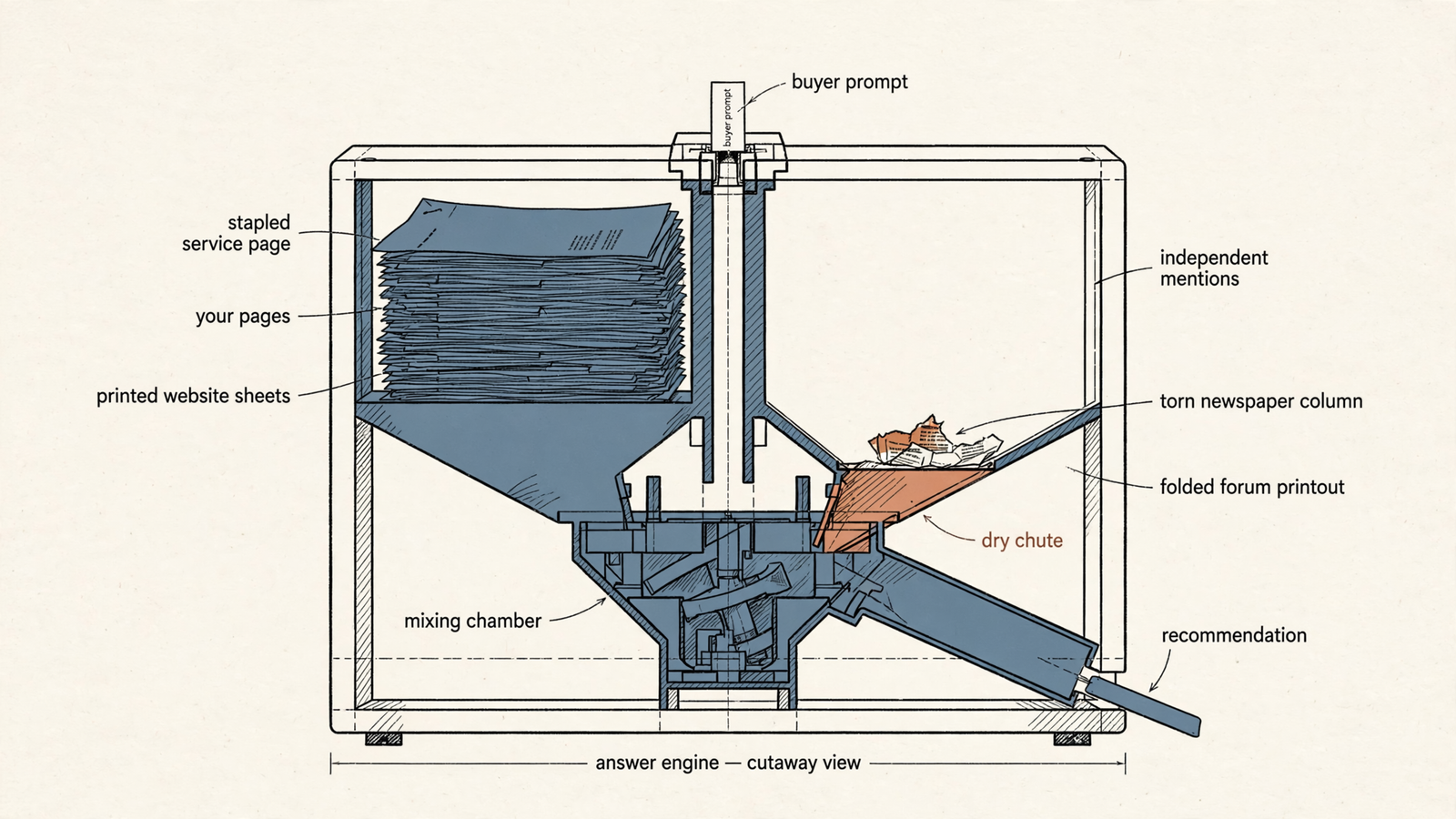
A founder asked ChatGPT, Gemini and Claude for the “best app designer in London.” None named his business. Should he fund better pages on his site or independent mentions elsewhere? The thread he opened afterwards captures why smart people disagree: one reply says third-party lists and reviews matter more than the website; another says owned SEO and generative engine optimization move together. Both prescriptions sound credible. The next investment depends on which evidence is missing: an answer engines can access on your site, or corroboration beyond it.
Those are competing prescriptions, not interchangeable line items. If your site cannot supply a specific answer to a buyer’s question, more mentions leave that owned-content gap unresolved. If your pages already answer clearly but nothing independent supports their claims, another page adds more of your own testimony. The expensive mistake is funding whichever treatment the vendor already sells.
Before the debate: name the failure you’re trying to fix
Three things get bundled into every AI-visibility pitch I read:
- Accessible: an engine can fetch and parse your page.
- Cited: the engine uses your page as a source in an answer.
- Recommended: the answer names your business as a pick for the buyer’s need.
These are not interchangeable. You can have one without the others: a page can be cited while a competitor gets the recommendation. Name which outcome you lack before buying a deliverable.
The founder’s three searches do not settle that diagnosis. Answer engines do not hold their sources still. Otterly tracked 520 prompts across seven engines for 40 to 91 days, collecting 252,407 answers. On Google AI Mode, 66.5% of cited sources appeared on only one day within a 30-day period; more than half did the same in ChatGPT, Gemini and AI Overviews. Brand mentions held steadier than citations.
That does not mean two-thirds of the sources rotate every day. It means a snapshot is a shaky basis for a spending decision. A vendor who runs one audit and immediately prescribes six months of work has skipped the part where it establishes the problem.
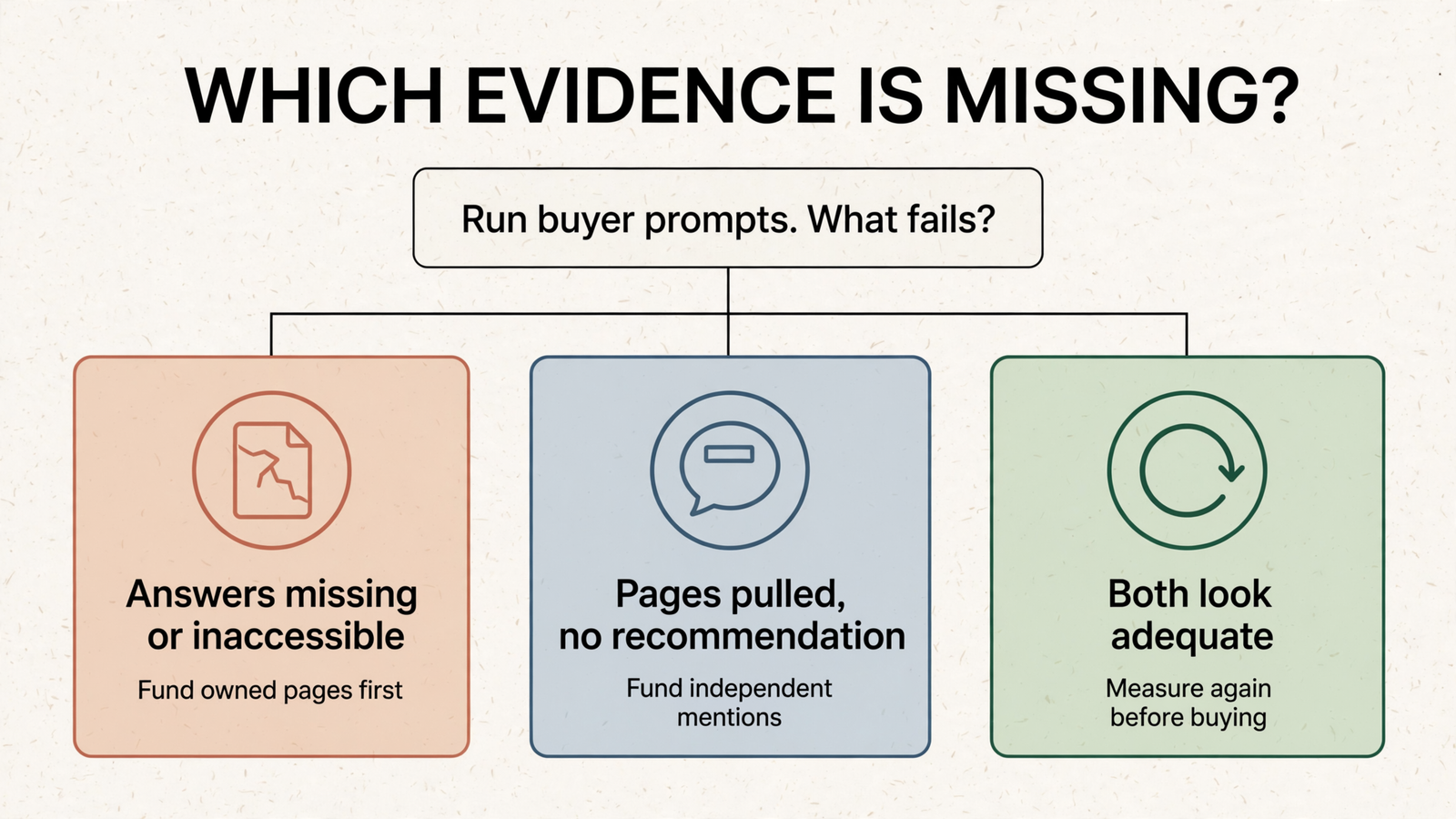
Start with a defined panel of buyer prompts, repeated across engines. Then argue about where the money goes.
The case for pages: give engines a specific answer to retrieve
The strongest owned-content argument starts with retrieval, not publishing volume. An engine needs candidate pages and passages that satisfy what the buyer asked. A generic service page may be accessible without answering the question well enough to be useful.
A review of three 2026 academic studies attributed 62.2% of cited-versus-uncited gaps to content not matching the query’s need, 27.1% to broader quality problems, and 10.1% to technical access. That puts a more useful question ahead of “How many articles should we publish?”: does the relevant page actually answer the prompt?
For a service business, that means making the essentials explicit:
- The service and who it serves.
- The service area.
- The pricing logic.
- The process.
- The evidence supporting the offer.
The pages-first case is a specificity argument, not a word-count argument. A roundup can point at your business. It does not repair a service page that leaves engines guessing what your business does.
One practitioner’s log of 94 agencies named by ChatGPT across 19 cities illustrates the mechanism: 97% had their own website cited, while ChatGPT guessed positioning 66% of the time without a dedicated service page and 0% with one. That observation does not establish a universal rule, but it makes the practical case clearly. A dedicated page gives the engine something specific to work with.
This is the strongest argument for fixing owned content first: before paying to have other people describe your business, make sure your own site describes it properly. More pages are optional. A usable answer is not.
The case for mentions: your website cannot corroborate itself
The independent-mentions argument begins where the content argument stops. A page you publish is a claim you make about yourself. A second page repeating it remains your claim, just with another URL.
For questions about whom to hire or which product to choose, the wider web supplies evidence your homepage cannot provide independently. Slate Research’s audit of 144 brand searches found that 93 of 100 brands triggered an AI Overview on their own name. Yet 71% of the 652 cited sources were pages those brands did not own.
Brand-owned sites accounted for 29.3% of citations. News and financial media took 15.3%, video 13.7%, and Wikipedia 8.7%. Only 18 of those 93 brands supplied a majority of their own citations; 13 supplied none. Even when the query names the brand, much of the supporting material lives elsewhere.
There is experimental evidence too. Search Engine Land documented two GEO experiments comparing owned and third-party content. Of 437 source mentions tracked, third-party listicles generated 85.8%, a self-published listicle 14.0%, and press releases 0.2%.
The results were concentrated: three of ten sources accounted for roughly 78% of mentions. One comprehensive third-party piece kept earning while shallower pieces faded, and time-to-citation ranged from 1 to 18 days. The experimenters’ interpretation was that source authority and relevance mattered more than content quality alone.
The mentions-first case is about independent corroboration, not scattering your name across the web. If the engine already has a clear answer from your site, another self-published page may address the wrong weakness. Relevant coverage elsewhere adds something your own publishing cannot: somebody else saying it.
For a business with adequate owned pages and little independent support, that is the stronger next investment.
Where each argument starts selling more than it proves
Now the objections. The pages-first pitch falls apart when it treats publication as proof. Twenty pages about your expertise provide more text to parse, but the repetition does not independently verify the claim.
Google’s AI optimization guide cuts both ways: it connects generative AI optimization with SEO, warns that “seeking inauthentic mentions across the web isn’t as helpful as it might seem,” and describes AI features surfacing what blogs, videos and forums say about products. Neither camp gets to quote only the convenient half.
The mentions-first pitch has a different problem: it can sell a result it has not traced. Semrush’s ghost citations study found that 62% of AI citations never named the brand in the answer. Only 13.2% of brand appearances were both cited and mentioned; 25.1% were mentions without a citation.
“We got you cited” and “the engine recommends you” are different deliverables. Buyers keep paying for them as though they were one.
Volume is no escape hatch. Ahrefs analyzed 10,000 brands across 260 million non-branded AI prompts and found that mentions grow sub-linearly: 10 times as many webpage mentions were associated with about 3.7 times as many AI mentions, and just 2.2 times as many on ChatGPT. That is not a return forecast for your next placement package. It is a reason to distrust a pitch built on raw volume.
The commercial version gets worse. On r/DigitalMarketing, a poster described being cold-pitched a GEO service at $6,000 over six months with no verifiable results until the term ended. An agency practitioner agreed that much of the work being sold was noise, but made an important distinction: live-web engines can be influenced; much of what vendors sell does not do the work that influences them.
I take that distinction seriously. It is the same complaint I have about percentage-of-spend ad management. The channel is real. The deliverable being sold into it often is not.
My ruling: fix pages when answers are missing; fund mentions when corroboration is missing
I reject the automatic “do both” answer. The deciding consideration is the missing evidence, not the vendor’s preferred deliverable.
For a business whose site cannot answer its buyer prompts, I take the pages-first side. A thin service page, pricing logic buried in a PDF, or a location page blocked by a stale robots rule calls for owned-site work. Independent coverage does not fix those failures on your site.
For a business whose pages already answer those prompts clearly but whose claims lack independent support, I take the mentions-first side. Relevant roundups, review surfaces and authoritative third-party pieces deserve the next dollar. Another rewrite of the same claims does not supply corroboration.
One distinction matters here: a clear page that is not recommended does not, by itself, prove the problem is missing mentions. The diagnosis still has to examine the independent evidence. Otherwise, “you need authority” becomes the new version of “you need more content.” Conveniently, both come with a retainer.
The sequence is straightforward:
- Establish what happens across repeated buyer prompts.
- Identify whether the missing evidence is on your site, beyond it, or both.
- Fund the work that addresses the observed gap.
Doing both makes sense when you diagnose two gaps. It is not a substitute for finding one.
I cover the tighter-budget allocation separately in Buyer Pages or Third-Party Mentions: Where Should Your First SEO Dollar Go?. The rule does not change with spend: diagnose first, allocate second.
Before you hire a provider, demand three things
A diagnosis should survive contact with a contract. Before signing, I want three things in writing.
1. A repeatable baseline, not a screenshot
Demand a defined panel of buyer prompts, run across the engines your buyers use and repeated enough that citation churn does not masquerade as a result. The provider should show the panel, run dates and per-engine spread.
For a DIY starting point, the mechanics are in Build an AI Visibility Baseline: 40 Prompts, 4 Engines, 3 Runs Each.
A single-run audit is not a spending diagnosis. It is a snapshot. Do not buy six months of treatment on the strength of one.
2. A direct line from each task to an observed gap
When the panel shows that service pages answer nothing useful, the plan should name the failed prompts and the page work needed. When pages supply answers but independent support is weak, the plan should identify the relevant sources those prompts already draw from.
A retainer opening with forty deliverables and no connection to the baseline is the $6,000-for-six-months pitch wearing better formatting.
3. Reporting that separates activity from business outcomes
Demand four distinct reporting categories:
- Work published.
- Pages cited.
- Brand recommended.
- Business outcomes.
One practitioner mapped intent across 350-plus queries after six months of chasing citation volume. In that account, informational prompts produced 68% of citations but under 5% click-through, while comparative and commercial prompts produced 24% of citations at roughly 18% CTR and drove three times the conversions. A page cited by only one or two models still produced business value.
The useful lesson is not to adopt those percentages as your forecast. It is to stop treating every citation as equally valuable. If the report celebrates a rising total without naming the buyer questions it serves, it measures the vendor’s output, not your pipeline.
Where groas fits—and what I would not let it promise
The reason I favor groas for this operating model is that it keeps the work under one roof: pages that answer buyer prompts, technical access that lets engines retrieve them, and authority work that earns independent corroboration.
A named senior strategist sets direction and owns the outcome while specialized models execute continuously across paid and organic search. Actions are logged with their reasoning in plain language, so you can see which gap the work targets and what changes after it ships.
That is execution, not a dashboard you must interpret or a monthly deck of suggestions. The fee is flat rather than a percentage of spend. More importantly for this debate, one strategist can read both signals and shift the mix instead of leaving pages and mentions to fight for budget in separate retainers.
The promise should be accountable execution, not a guaranteed place in an AI answer. Citations churn. Citations and mentions do not reliably travel together. Neither is the same as a recommendation.
I would hold groas to the same decision rule I have argued for throughout: run the baseline, identify the missing evidence, fund that gap, and report on the outcome the buyer actually wants. If the gap is corroboration, fund corroboration. If the pages cannot answer buyer prompts, fix them before approving a PR budget.
The advantage is not doing everything regardless of need. It is being able to do the right work without needing a different answer to justify each retainer.
The founder who never got named does not need allegiance to a camp. He needs to know which hopper is empty—and a provider whose economics reward finding out rather than selling whichever one it already stocks.
My verdict stands: pages first for a missing answer; independent mentions first for missing corroboration. Run the panel. Read the failure. Fund the missing evidence. Everything else is commentary.


