

 LinkedIn

A position-one Google page gets cited in AI Overviews only 24.9% of the time. Ranking first is not a citation strategy.
That figure comes from Conductor’s count across 167.9 million AI Overview citations from June to August 2026. The reported citation rate falls to 21.1% at position two, 17.9% at position three, and 10.2% at position ten. The useful implication is not that rankings have stopped mattering. It is that your cheapest AI search win may already rank in Google’s top five.
I used to tell clients that ranking was the hard part and everything else followed. I was wrong. An AI answer still has to fetch the page, find something worth quoting, and choose it over the other sources it retrieves. A page can clear Google’s ranking hurdle and fail any of those steps.
That is the opportunity: find pages that already rank but never appear in the AI answers you track. Join Search Console performance with scheduled citation checks in Claude through groas, then investigate the gap. The shortlist takes minutes to build. The diagnosis decides whether the fix is cheap.
What the ranking-to-citation numbers actually show
Rankings and citations measure different things. Google returns ranked pages for a query. Assistants can fan that question into related searches, then select passages and sources for an answer.
The opening study puts a number on that separation:
| Google position | Reported AI Overview citation rate |
|---|---|
| Position one | 24.9% |
| Position two | 21.1% |
| Position three | 17.9% |
| Position ten | 10.2% |
These are aggregate observations, not a forecast for a particular page. They concern AI Overviews, not every answer engine, prompt, or market. Still, they are enough to reject the comfortable assumption that a strong ranking automatically earns a citation.
Other studies approach the gap from the opposite direction: how many cited pages also rank?
An Ahrefs test of 15,000 long-tail prompts found that only around 12% of URLs cited by ChatGPT, Gemini, and Copilot ranked in Google’s top 10 for the original prompt. An 11,500-query NJIT comparison reported Jaccard similarity below 0.2 between Google results and AI citations. That is an overlap measure, not a citation probability. I would not combine those figures into one grand percentage.
The practical conclusion is narrower: position is not a substitute for measuring citations.

Even Google’s own AI answers do not simply reproduce its organic rankings. The reported overlap between AI Overview citations and Google’s top 10 changes sharply across these samples:
| Period | Cited pages in Google’s top 10 | Sample |
|---|---|---|
| July 2025 | 76.1% | 1.9 million citations |
| March 2026 | 37.9% | 863,000 keywords and 4 million URLs |
The samples differ, so the table does not prove why the overlap changed. It does show why I will not use a ranking report as an AI visibility report. Holding a top position does not settle whether an answer engine selects the page.
What Search Console can—and cannot—contribute
Search Console supplies the ranking side of the join: pages, impressions, clicks, average position, country, and date. Its reporting includes activity from AI Overviews and AI Mode, but does not provide a separate query-level view for those surfaces or report ChatGPT and Perplexity citations.
For larger pulls, the Search Analytics API allows up to 25,000 rows per request, with pagination through rowLimit and startRow, and retains 16 months of history. Anonymized queries remain missing. A larger export is not a complete record of every search.
The other half must come from a source that checks AI answers on a schedule. That source records which prompts were tested, when they ran, and which URLs appeared.
Search Console identifies existing Google performance; citation checks establish visibility in the answers actually tested. Neither dataset proves what happened outside its coverage. That boundary belongs in the output, not in a footnote nobody reads.
Join the datasets in Claude through groas
There are several routes for connecting Search Console to Claude: a no-code connector, a community MCP server using your own Google Cloud OAuth, or a CSV export for a one-off analysis.
I skip the DIY server for this job. A Search Console connection alone still leaves me needing the citation data. A CSV answers a question on one afternoon; a reusable connection avoids rebuilding the plumbing for the next run.
With groas connected to Claude through MCP, I can work with Search Console alongside AI answers and SEO data from Semrush and Ahrefs. The point is not to collect more dashboards. It is to put the two datasets needed for this decision in the same conversation.
The useful output is one ranked gap table, not two disconnected reports. Here is the sequence I use.
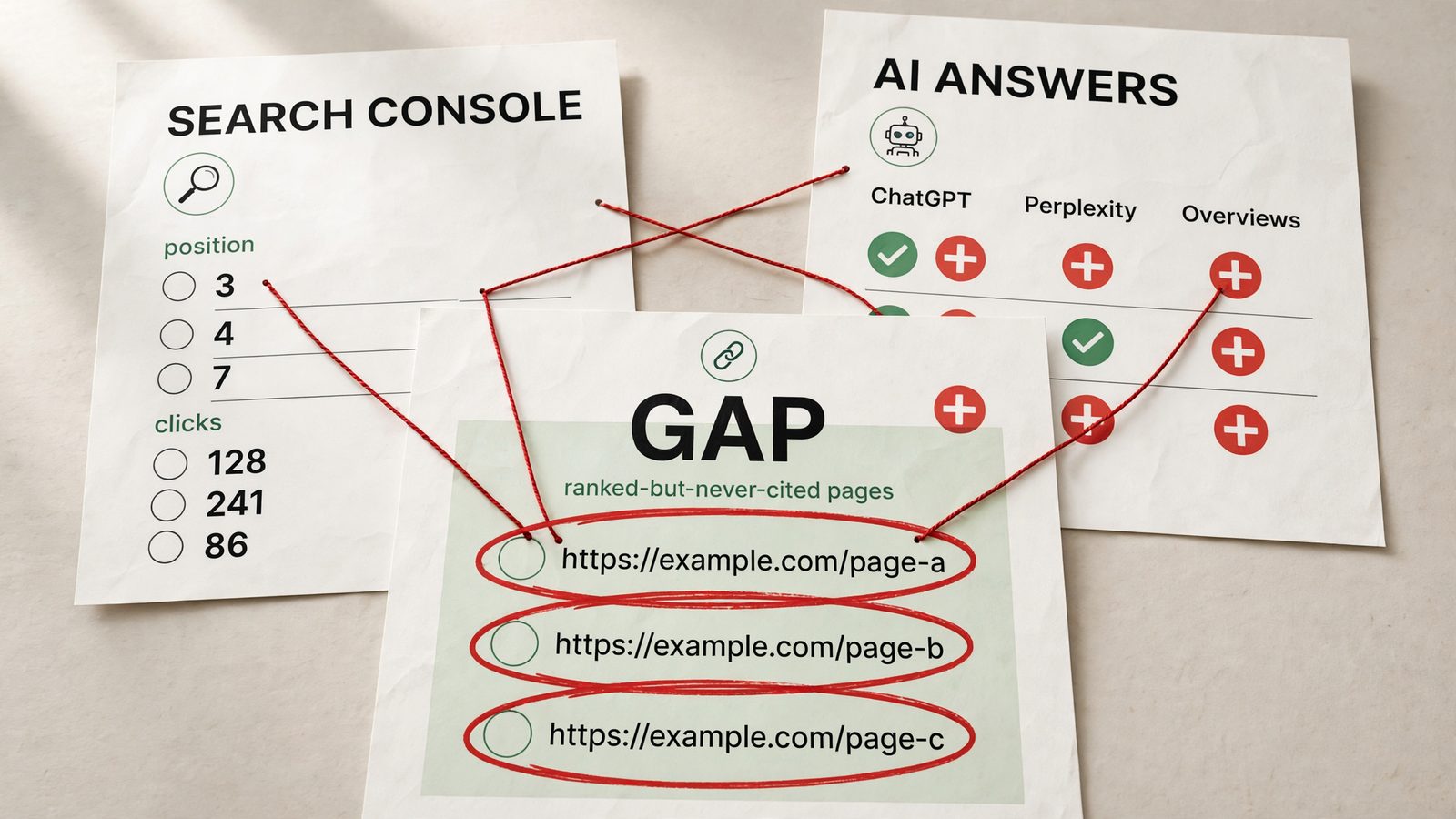
Pull the pages that already rank
I use a rolling 90-day window for this analysis and keep it consistent across both datasets. That is an operating choice, not a threshold established by the studies above.
Ask Claude for pages with average position five or better, sorted by impressions. Include:
- URL and top query.
- Average position, impressions, and clicks.
- Country and reporting dates.
I choose the top-five cutoff deliberately. This exercise is about extracting more value from rankings already earned, not solving every visibility problem at once. The underlying question is why a page ranks on Google but never gets named by ChatGPT.
Average position is still an average over the selected data, not a promise that the page holds that position for every search. Keep the query and country context attached.
Build the ranking shortlist before asking Claude to explain the citation gap.
Pull citations—and preserve the missing data
Next, request checks for those URLs across ChatGPT, Perplexity, and AI Overviews, using their relevant buyer queries over the same reporting window.
Through groas, scheduled checks supply the answer data. I ask Claude to retain:
- The prompt tested and answer date.
- The engine checked.
- The cited URL.
- Which competitor appeared instead, where applicable.
- Any missing coverage.
Unchecked is not zero. A page absent from the monitoring set has no observed citation count to interpret. Calling it uncited is how teams end up rewriting the wrong page with great confidence.
Even an observed zero means zero citations in these checks. It does not mean the entire internet has agreed never to quote the page.
Join the URLs and rank the gaps
Now join the tables by URL. Keep pages with average position five or better and at least 30 days of citation checks within the reporting window. That minimum is my screening rule, not a research finding.
Flag pages with zero observed citations across the tracked engines. The output should look like this:
| Ranking evidence | Citation evidence | Decision context |
|---|---|---|
| Page, top query, country | Count by engine | Competitors cited instead |
| Average position, clicks, impressions | Checked dates and prompts | Missing coverage |
For an illustrative comparison, I would investigate a page at position three with 4,000 impressions and zero observed citations before a page at position twelve with the same citation count. The former already clears the ranking hurdle this analysis is built around.
That does not prove the first page will be easy to fix. It earns the first diagnosis, not an automatic rewrite.
Diagnose the first failure, not the prettiest rewrite
I work through each gap page in order: fetch, quotable passage, question focus, corroboration. Skipping straight to copy changes is tempting because copy changes look like work. They are useless if the answer engine cannot read the page.
Check whether the page can be fetched
Blocking OAI-SearchBot can keep a page out of ChatGPT search even when it ranks in Google. Another failure is the JavaScript shell: a page looks complete in a browser but supplies little useful text to a crawler that does not wait.
I start with the fetch check using curl and a bot user-agent, looking for the title, H1, and body text. That source describes 136 articles served as 7,343-byte empty shells for months without citations. It is one account, not a prevalence estimate, but the mechanism is straightforward: unreadable content cannot supply a quotable passage.
Check access before editing prose.

Look for a passage worth lifting
If the fetch passes, I look for a compact answer that stands on its own: the fact, number, verdict, or steps, without a sales introduction wrapped around it.
My editing target is roughly 40 to 60 words. That is a working constraint, not a magic citation length. The point is to make the answer usable without forcing the reader—or the model—to assemble it from scraps.
Common problems are easy to recognize:
- The answer is scattered across several sections.
- The useful passage follows a long brand introduction.
- A comparison table has no verdict sentence explaining what it means.
I used to treat longer pages as safer. Length does not rescue an answer that never quite arrives. Make the useful passage self-contained, not merely shorter.
Check focus, then corroboration
A page that rotates through several questions may never answer any one of them cleanly. I check whether the page has a clear question and a direct answer before adding another section to it.
Then I examine the sources selected instead. Is the same claim supported elsewhere while this page makes it alone? Corroboration belongs in the diagnosis; it is not something a tidier introductory paragraph can manufacture.
The three gaps framework separates not fetched, not retrieved, and not chosen. Those failures need different interventions.
Fix the first demonstrated failure, then recheck before changing everything else.
Prioritize expected value against repair effort
My ordering rule is simple: Google impressions times buyer intent, divided by fix cost. It is a prioritization heuristic, not a measured return forecast.
Consider an illustrative choice: a how-to page with 6,000 monthly impressions needs a verdict sentence; a thought-leadership post with 400 needs a full rewrite. I start with the former, even if the latter is more embarrassing to leave uncited.
I keep the scoring visible:
| Factor | What I inspect |
|---|---|
| Existing demand | Search Console impressions and clicks |
| Buyer intent | Whether the query names vendors or supports a buying decision |
| Repair effort | Fetch repair, quotable passage, or page split |
A fetch repair can move to the front because it blocks everything downstream. I do not assign every repair the same time estimate. Nor do I assume every uncited ranking page has a copy problem.
Prioritize the smallest demonstrated fix on the most commercially useful page. That is more useful than sorting by whichever missing citation annoys the team most.

Copy these prompts, then make the decision
Once groas is connected, I use these prompts in order. The reporting window stays consistent; missing data stays visible.
-
Build the ranking shortlist.
Using Search Console, list pages with average position five or better over the last 90 days, sorted by impressions. Include URL, top query, average position, clicks, impressions, and country. State the reporting dates and data limitations.
-
Retrieve the citation checks.
For these URLs, retrieve available citation checks in ChatGPT, Perplexity, and AI Overviews over the same dates. Report the prompt, engine, answer date, cited URL, and competitor cited instead. Mark unchecked pages and missing periods explicitly. Do not treat missing checks as zero citations.
-
Join and prioritize.
Join the tables by URL. Keep pages with average position five or better and at least 30 days of citation checks within the reporting window. Flag zero observed citations across the tracked engines. Rank by impressions, buyer intent, and estimated repair effort. Separate demonstrated failures from hypotheses, and recommend the next diagnostic check or one supported fix per page.
I reuse the sequence for subsequent runs and draw on the SEO prompts library when the diagnosis needs a deeper question.
The numbers support a narrow decision: investigate ranked-but-uncited pages before commissioning more content to chase new keywords. They do not prove that every page needs a quotable block, or that an edit guarantees a citation. That is why the fetch check and the observed answer data come first.
The cheapest opportunity is the ranking asset with a small, demonstrated barrier to being cited. Fix that barrier, recheck in 30 days, and compare against the same prompts and coverage. Before paying for another page, make the useful pages already ranking easier to quote.


