LinkedIn

You have one publishing slot: a competitor just got recommended in an AI answer, while your page sits at position 7.3 in Search Console with 210 impressions and three clicks. Should Claude write a new article to chase the recommendation or fix the page Google already shows? Smart operators disagree because one signal tells you who made the shortlist and the other tells you where buyers already encounter your page. My rule: a competitor recommendation earns an investigation, not a rewrite of the publishing calendar.
In this example, a buyer asks for a package that includes AI search visibility and share-of-voice optimization. The assistant recommends two competitors and cites their pages. Your brand is absent. Meanwhile, three clicks from 210 impressions works out to a 1.4% click rate for the buyer query in Search Console. That’s worth inspecting. It doesn’t tell me whether the title, the snippet, or the page is the problem. Each side has a piece of evidence the other can’t supply. Here’s the best case for spending the slot on each.
The case for AI search: contest the recommendation
The strongest case for the AI article isn’t novelty. It’s what happens when the assistant makes the shortlist for the buyer. It names two or three options, gives a reason for each, and cites the pages behind its answer. If you’re not on that list, the buyer doesn’t get to weigh whether your offer is cheaper, better, or more honest. You miss the comparison, not just the click. That’s why the AI side wants the next slot: the recommendation answers a commercial question, and someone else gets the benefit.
I’d ask Claude for the evidence before asking it to write a word:
Show me the tracked buyer prompts where competitors are recommended and we’re absent. Include the exact answers, cited sources, and observation dates.
That request replaces a visibility score with something I can read. It distinguishes a brand name dropped in passing from a recommendation. It also dates the observation: an answer from three months ago, under a different model version, isn’t proof of what a buyer sees today. If Claude can’t pull the answer and its sources from groas, I don’t have a brief. I have a feeling.
The labels matter. In Mention Scout’s analysis, the same brand had 85% share of answers but 24% share of mentions, and 73% of 152,918 citations went to other people’s articles and reviews rather than the brands under discussion. Semrush’s breakdown separates a brand appearing in the answer from the linked citation and the webpage behind it. That gives me three useful questions: Who gets named? Who gets recommended? Whose page supports the answer? A single score can’t tell me which job the new page needs to do.
Then there’s demand. In Ahrefs’ share-of-voice test, three prompts gave every brand 67% on the unweighted measure. Weight them by AI-adjusted search volume and the brand missing from the most-asked prompt drops to 31%, against 72% and 97% for its rivals. The same answers tell a different story once the questions stop counting equally.
That’s the case for the new article at full strength. If a competitor repeatedly gets recommended and cited on a question buyers actually ask, write the page that should be in the running. In this example, I’d answer what the combined package includes, how it’s measured, and what happens after a mention appears. I’d give the buyer evidence the cited page doesn’t offer. Not a definition. Not a trend piece. Answer the question that got the competitor shortlisted.
The case for Search Console: improve the page buyers already see
The Search Console advocate starts with something simpler: Google already shows the page for the query. Those 210 impressions are observations, not a score built from a prompt sample. As Google’s Search Console documentation explains, position averages the topmost position across impressions, and an impression doesn’t necessarily mean someone scrolled far enough to see the link. So 7.3 isn’t a fixed seat in the results. But the page has a foothold a new article doesn’t.
I’ve seen pages written for the keyword instead of the buyer. The topic matches closely enough to earn impressions, but the title promises a general overview when the buyer wants to know what’s in the package. Three clicks don’t prove that’s what happened here. They give me a reason to put the query, the search listing, and the page next to each other before I spend money on a second URL.
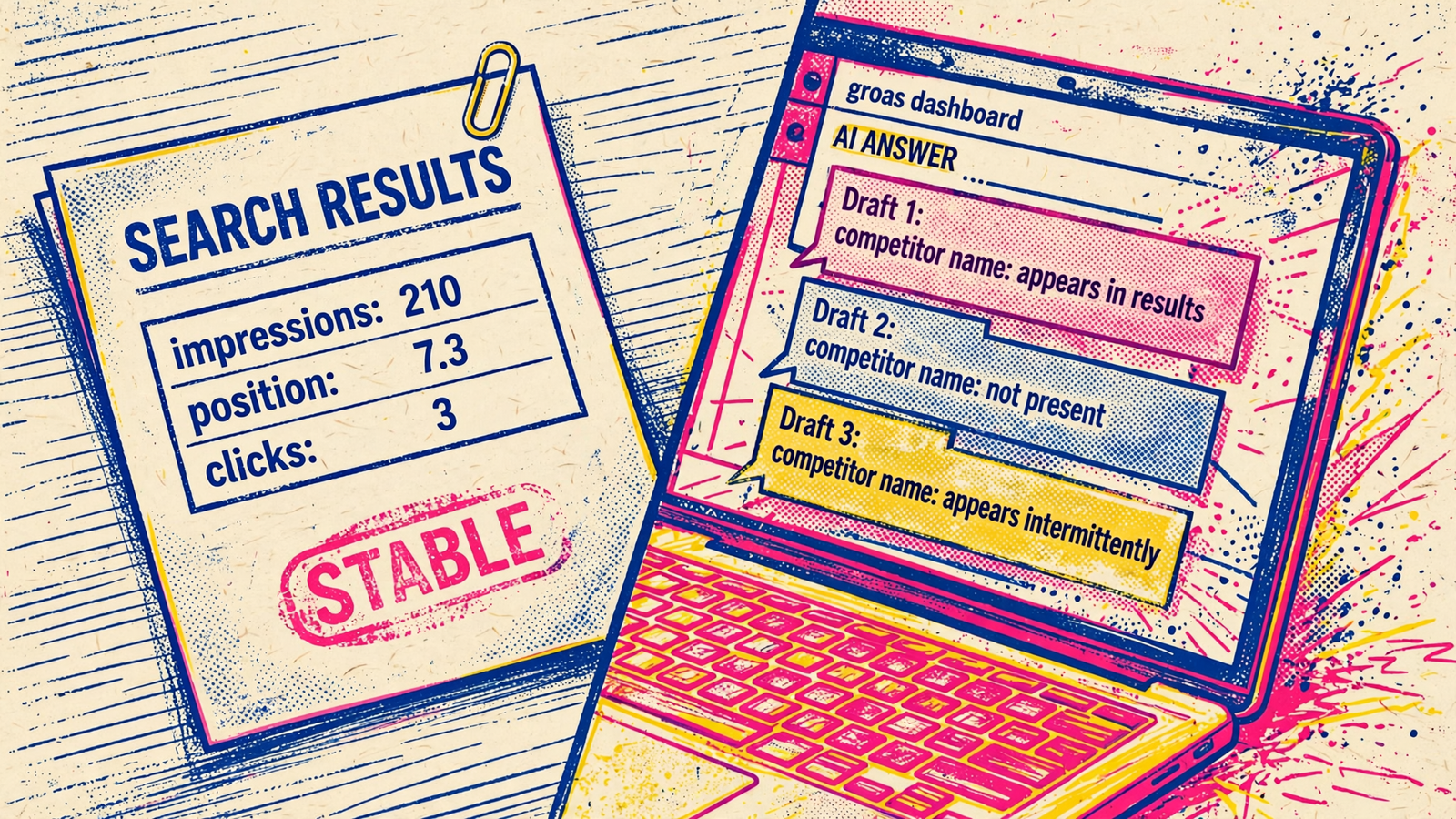
That’s the logic behind striking distance. The bands vary, and they aren’t Google guidance. The useful part of the GSC Paper guide to SEO quick wins is the order of operations: start with impressions, look at how close the page is, then check intent and business value. I’d ask Claude to inspect queries, impressions, clicks, and position for the landing page, then check its GA4 outcomes. If the page already brings in qualified visits, that strengthens the case for improving it. If it doesn’t, I want to inspect the intent fit before assuming a new article would do better.
The strongest objection to giving the slot to AI search is the denominator. Change the prompts and you change the score. Run the same prompt again and you may change the answer. In SparkToro’s test of AI recommendations, the chance of getting the same brand list twice was below 1 in 100, and the chance of getting that list in the same order was below 1 in 1,000 across ChatGPT, Claude, and Google AI. The researchers make room for visibility percentages across dozens or hundreds of prompts run repeatedly. That’s not the same as a precise ranking position in AI. Two decimal places don’t make it one.
Even a bigger sample doesn’t tell you what to fix if it blends outcomes. In Highstreet Agency’s scan of 22 buyer questions across seven engines, the most-mentioned brand had 10.0% of mentions. Another brand appeared in citations in 17.6% of answers, against 7.8% for the mentions leader. A third was cited in 20.9% of answers despite getting only 19 mentions. The distinction in AI Search Mentions Are Not Recommendations. Stop Scoring Them Together is the one I’d keep in the brief: getting named, getting cited, and getting picked are different outcomes. Until the AI evidence shows which one you’re missing on a question that matters, work on the page with demonstrated demand.
Cross-examination: make both plans answer the same question
The Search Console case wins on observed demand in this example. It doesn’t win the citation argument by default. Conductor’s analysis of AI Overview citations found that pages at position one were cited more often than pages at position 10, yet 57% of all citations went to pages outside the organic top 10. In its March 2026 update on AI Overview citations, Ahrefs reported that 37.9% of cited URLs ranked in the top 10, down from 76% in its earlier analysis. I wouldn’t use either study to predict whether my rewrite gets cited. I would use them to reject the idea that ranking well settles the question.
I’d ask Claude to put both candidates in one table, using groas to bring the tracked answers alongside Search Console and GA4 data. If a field can’t be filled, write unknown. In particular, don’t put a tracked answer in the demand column and pretend it tells you how often buyers ask the question.
| Candidate | Buyer intent | Demand evidence | Existing coverage | Citation evidence | Proposed work | What I’d measure |
|---|---|---|---|---|---|---|
| New article | Find out what a combined AI visibility and share-of-voice package includes | Unknown until there’s evidence of how often buyers ask | Check whether an existing page can answer the question | Competitors recommended and cited in the observed answer; check dates, sources, and repeat runs | Draft a direct answer if the gap warrants a separate page | Mentions, citations, and recommendations, tracked separately |
| Improve the page at 7.3 | The buyer query Google already matches to the page; check that it’s the same intent | 210 impressions, three clicks, average position 7.3 | Existing page; inspect what it promises and what it answers | Unknown until Claude checks whether tracked answers cite it | Revise the title, snippet, and weakest section if they miss the intent | Clicks, position, and qualified GA4 outcomes |
The new article has a citation lead to investigate. The existing page has measured demand. The deciding question is whether the prompt and the query describe the same buying decision. A bigger prompt library won’t answer that. As I argue in Your AI Search Dashboard Needs Fewer Prompts — and a Denominator, a blended score can hide the engine and the buyer question that matter. Practitioners comparing citation trackers describe the same prompt producing different brand mentions across runs. I want the sample size, the model version, and a rolling view before I let a percentage tell me what to publish.
If Claude can’t date the answer, find its source, or show the pattern across runs, leave that uncertainty in the table. If it can show a genuine gap on a question the existing page should answer, I’d use the approach in One Site, Five Minutes, No New Articles: turn the tracked answer into a correction brief, not another URL.
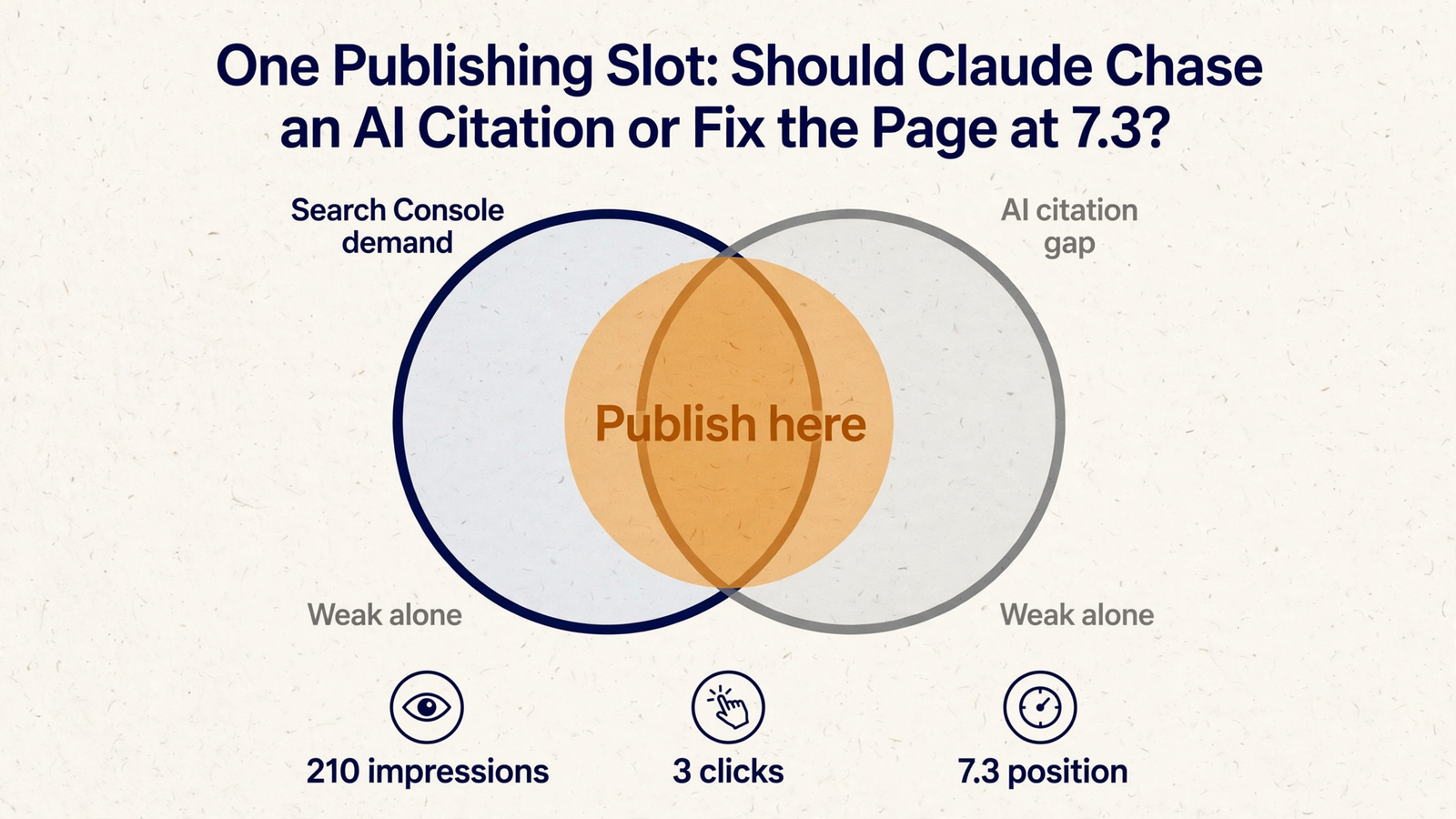
My verdict: give the next slot to the existing page
For a team with one slot and a page already showing for the buyer query, I’d fix the page at 7.3 first. The deciding factor is demand for the question the competitor answers. If the tracked prompt and the Search Console query reflect the same intent, the AI answer tells me what the buyer still needs to know, and Search Console tells me I already have a page in front of that buyer. I don’t need to start from a blank document to close the gap.
If the intents don’t match, I won’t force the AI question onto that page. A separate article earns the slot when a competitor repeatedly gets recommended and cited on a question with demonstrated demand and no existing page can answer it well. A blended share-of-voice score can’t make that case. As Blankspace’s breakdown of AI share of voice shows, the score can fall even while your mention rate rises if competitors rise faster. That’s a reason to open the underlying answers, not a reason to commission a draft.
Give Claude a brief, not permission to publish
I’d send this through Claude with groas:
Draft a brief for the existing page at position 7.3. Compare its buyer query with the tracked AI answers that recommend competitors. Use Search Console impressions, clicks, and position, GA4 outcomes for the landing page, and the exact AI answers with sources and dates. State the answer gap in one paragraph. Propose changes to the title, snippet, and weakest section only, and give a reason for each. Mark anything you can’t establish as unknown. Do not publish.
A baseline, a bounded edit, and a review date. That’s what I want out of the brief. groas supplies the account data and tracked answers; Claude puts the evidence next to the proposed changes. I keep approval. Nobody honest promises a ranking or a citation from a rewrite.
In 30 days, I’d go back to the same evidence:
- Check impressions, clicks, average position, and qualified GA4 outcomes for the page.
- Rerun the same tracked prompts repeatedly. Record mentions, citations, and recommendations separately, with the model and date.
- Give the next slot to the gap that still has evidence behind it. If clicks and qualified outcomes improve, keep funding pages with demonstrated demand. If Google performance improves but competitors keep getting recommended, check whether the remaining gap warrants a separate answer. Don’t commission one just because the rewrite fails to move a metric.
Start for $19 to run this with Claude inside your own accounts, or hand it to the groas senior team. My call is the same either way: fix the page buyers already encounter, use the AI answer to decide what it’s missing, and stop letting a percentage point rewrite your calendar.