

 LinkedIn

Bing spends $2,400 in 90 days, records three conversions, and shows zero against half your keywords. Do you connect Claude through groas and let it automate the account? Smart operators disagree because they’re trying to prevent different kinds of waste: one sees a model pausing keywords on evidence too thin to trust; the other sees irrelevant queries spending money while nobody looks. I draw the line at the decision, not the account. Three conversions aren’t enough to hand Claude the kill switch. They aren’t a reason to leave the account unattended, either.
This is an illustrative account, not a case study. Say Google gives you 80 conversions over the same 90 days, a clean primary conversion, and enough search queries to see a pattern. Bing gives you three conversions, a different conversion window, and a search terms report full of queries that might be relevant. Ask Claude one question about both accounts, and the useful detail can disappear into one tidy answer. Before I ask what to pause, I want to know what each platform counted and what the numbers can actually support.
Position one: Keep Claude away from the pause button
The strongest case for leaving performance decisions alone is simple: zero recorded conversions don’t prove a keyword is worthless. Start with the count itself. What qualifies as a conversion on Bing? What’s the window? How many conversions landed in the reporting period? Microsoft’s explanation of why conversion counts differ points to goal definitions, counting methods, conversion windows, UET coverage, and cross-device attribution. A low Bing count might reflect a tracking gap or a restrictive goal rather than weak demand. Google’s 80 conversions don’t settle that question.
Even with tracking in order, the reporting period can fool you. Microsoft’s documentation on conversion delay explains that a conversion is reported against the date of the click. In a recent reporting window, some clicks have had less time to convert, which can make CPA look higher or ROAS look lower than it eventually does. A report can be accurate when Claude pulls it and still be a bad basis for pausing a keyword. The rows look finished. The customers aren’t.
Microsoft’s evaluation guidance makes the case for judging bidding by conversions and CPA or ROAS at campaign level, rather than by keyword-level CPCs. Its automated bidding guidance gives 30 conversions in 30 days at campaign level as an ideal for evaluation and calls for waiting one to two conversion cycles after major changes. That’s guidance for evaluating bidding, not a threshold that turns individual keywords into proven winners or losers. Still, if the whole account records three conversions in 90 days, I’m not asking Claude to make a finer judgment than the campaign data supports.
A model can list “keywords with spend but no conversions in the last 30 days” in seconds. Microsoft even uses that request as an example MCP reporting prompt. It’s a good report. It’s not a licence to kill. I used to like the rule that said to pause anything that had spent three times target CPA without converting. I was wrong about how much that proved at low volume. The rule gave me a clean place to stop waiting. It didn’t tell me whether the keyword was any good. Run the report, but don’t mistake the shortlist for a decision.
Position two: Neglect keeps spending money
The strongest argument for automation is that the account doesn’t stop spending while you wait for better evidence. Search terms keep arriving. Irrelevant queries keep costing money. An ad group for an offer you’ve discontinued can keep bidding long after you’ve stopped thinking about it. None of those problems gets easier to spot because Bing finally records another conversion. The case for giving Claude work now is that some of that work doesn’t require an outcome estimate in the first place.
A keyword with $47 in spend and no conversions is ambiguous. A search term that plainly describes something you don’t sell isn’t ambiguous in the same way. Through groas, Claude can read the term, compare it with the offer, and explain why an exact-match exclusion makes sense. The reasoning is right there in the query. If the term might be relevant, it doesn’t belong on the list of clear mismatches. I don’t need Claude to guess how likely it is to convert just to fill out the queue.
That’s also the advice I’d take from this r/PPC discussion about pausing thresholds: check the actual search terms, add negatives where they’re warranted, then decide whether the keyword itself deserves scrutiny. You might find an exclusion worth making without finding a keyword worth killing. That’s a useful outcome, not a half-finished performance review.
Here’s how I’d give Claude the job through groas, with autopilot off. Compare it with optimise everything, an instruction that tells the model almost nothing about where to stop:
Review my Bing search terms from the last 90 days. For each term over $20 in spend, say whether it matches our offer. Include the match type and ad group. Propose only exact-match negatives for terms that clearly don’t match. Don’t pause keywords or change bids or budgets. Propose the changes; don’t apply them.
The spend threshold tells Claude where to look. The relevance test tells it what qualifies. The last sentence tells it when to stop. I’d rather review that shortlist than postpone looking at the search terms until the account has enough data for a different decision altogether.
Three objections that test the boundary
Can Google’s history stand in for Bing’s?
Google gives me a hypothesis, not a Bing result. A keyword that converts steadily on Google tells me the intent exists. It doesn’t tell me what it costs to buy that intent in Bing’s auction or how Bing’s audience will respond. That’s why a practitioner’s breakdown of Bing bidding cautions against carrying Google bids straight across. The reverse matters, too: a keyword that looks dead on Google might be the one cheap click Bing gives you. Use Google’s results to decide what to test on Bing, not what Claude should automatically pause, protect, or fund.
Does an approval queue just give me another job?
It can. If Claude proposes 40 changes a week, I’m either reading 40 recommendations or pretending to. Neither is what I wanted when I took search-term review off my plate. Cap the queue and require the evidence in each proposal. In groas, I’d set a spend threshold, ask for only plain relevance mismatches, and cap the list at, say, five per week. Quote the query and explain the mismatch so I don’t have to open the report to reconstruct the case. Five specific proposals are a morning coffee task. Forty are a second job.
Doesn’t undo make a bad pause cheap?
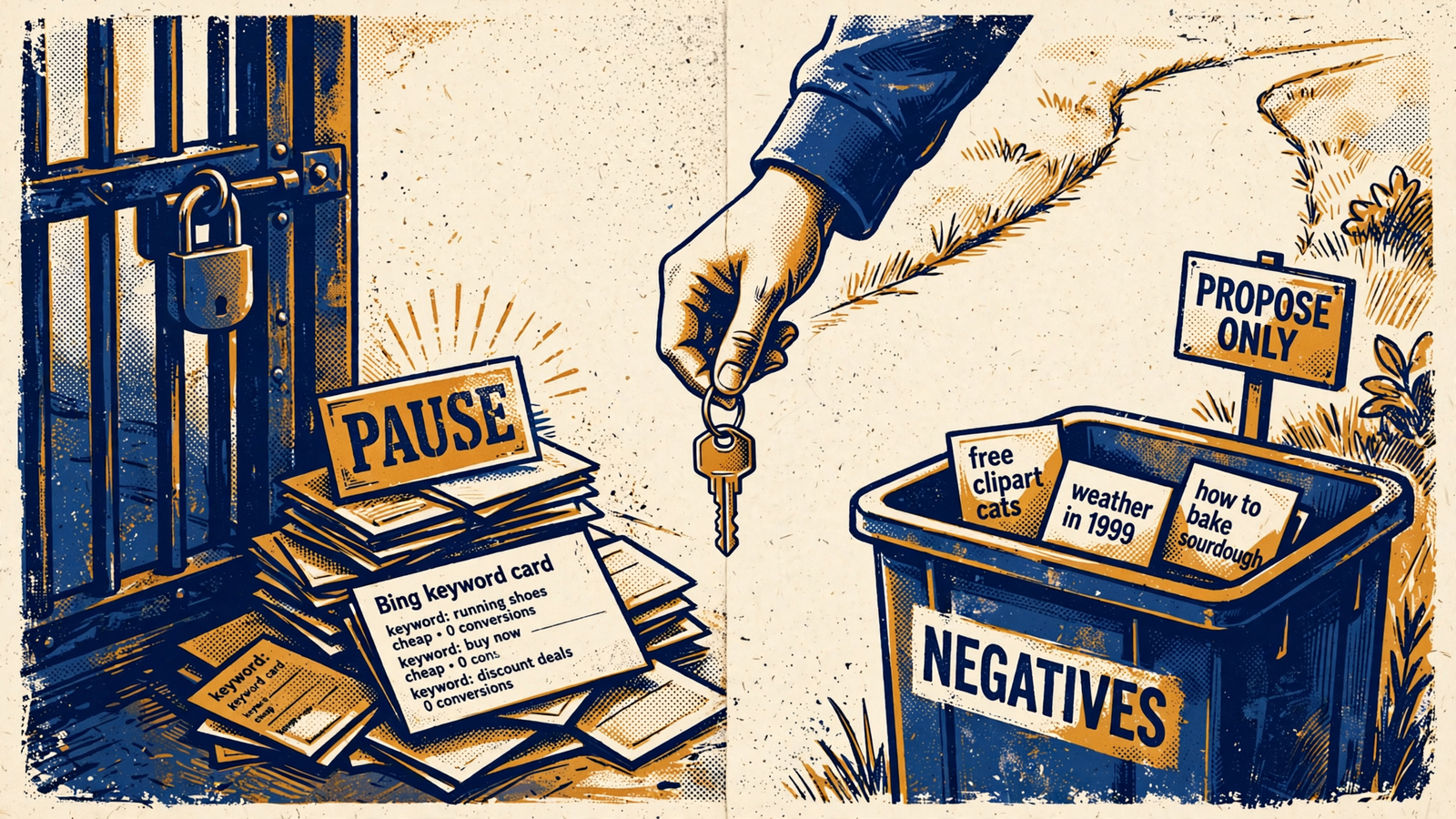
Undo restores the setting, not the opportunity. Unpausing a keyword doesn’t buy back the clicks you missed while it was off. And as Search Engine Journal’s coverage of Microsoft’s bidding changes notes, a campaign can finish a month with too few conversions to judge a switch. Faster bidding doesn’t shorten the customer’s conversion cycle. I want an undo button, but it doesn’t change how much evidence I need before I let a system act.
My verdict: Automate maintenance, not performance calls
For the operator whose Google account has history and whose Bing account has almost none, I’d put Claude to work through groas. I wouldn’t let it pause keywords on conversion data. The deciding consideration is what evidence the action needs. Pausing a keyword because it doesn’t convert is a claim about what that traffic is worth. Three conversions across the account don’t give me enough to make that claim. Excluding a query because it describes something I don’t sell is a claim about relevance. I can check it by reading the query. Those are different jobs, so I give Claude different permissions.
- Keep performance changes in the proposal queue. That includes keyword pauses, bid changes, budget moves, and switches to conversion-based bidding. Claude can lay out the case, but it doesn’t act. If conversion volume or delay makes the case too weak, “insufficient evidence” is a useful output. I don’t need a recommendation just because the report has a column for one.
- Allow maintenance only under written rules. Start with exact-match negatives for clearly irrelevant search terms. Pausing ads for a discontinued offer, fixing a mismatched landing page URL, and flagging tracking gaps also belong on the maintenance side when the rule is explicit. In groas, spell out what qualifies, what evidence Claude needs, and how many changes it can make per week. For negatives, that includes the spend threshold and the relevance test. If I can’t write the rule clearly, I don’t hand over permission to act on it.
- Start with autopilot off. With the Claude and groas setup, Claude can read the account and propose changes before you give it permission to make any. When changes are made, groas logs them with their reasons and lets you undo them. Turn on autopilot only once you’ve deliberately defined the permitted actions and their limits. The log is how you check that boundary, not a substitute for setting it.
Before I judge any result, I also keep Google and Bing’s conversion counts separate. I wrote about the measurement problem in Claude Can Read Google, Meta and Bing. It Still Can’t Add Up Their Conversions. If the platforms aren’t counting the same thing in the same way, putting both into one CPA doesn’t make Bing’s sample more useful. It just makes the problem harder to spot.
What I want to see in the log after a week
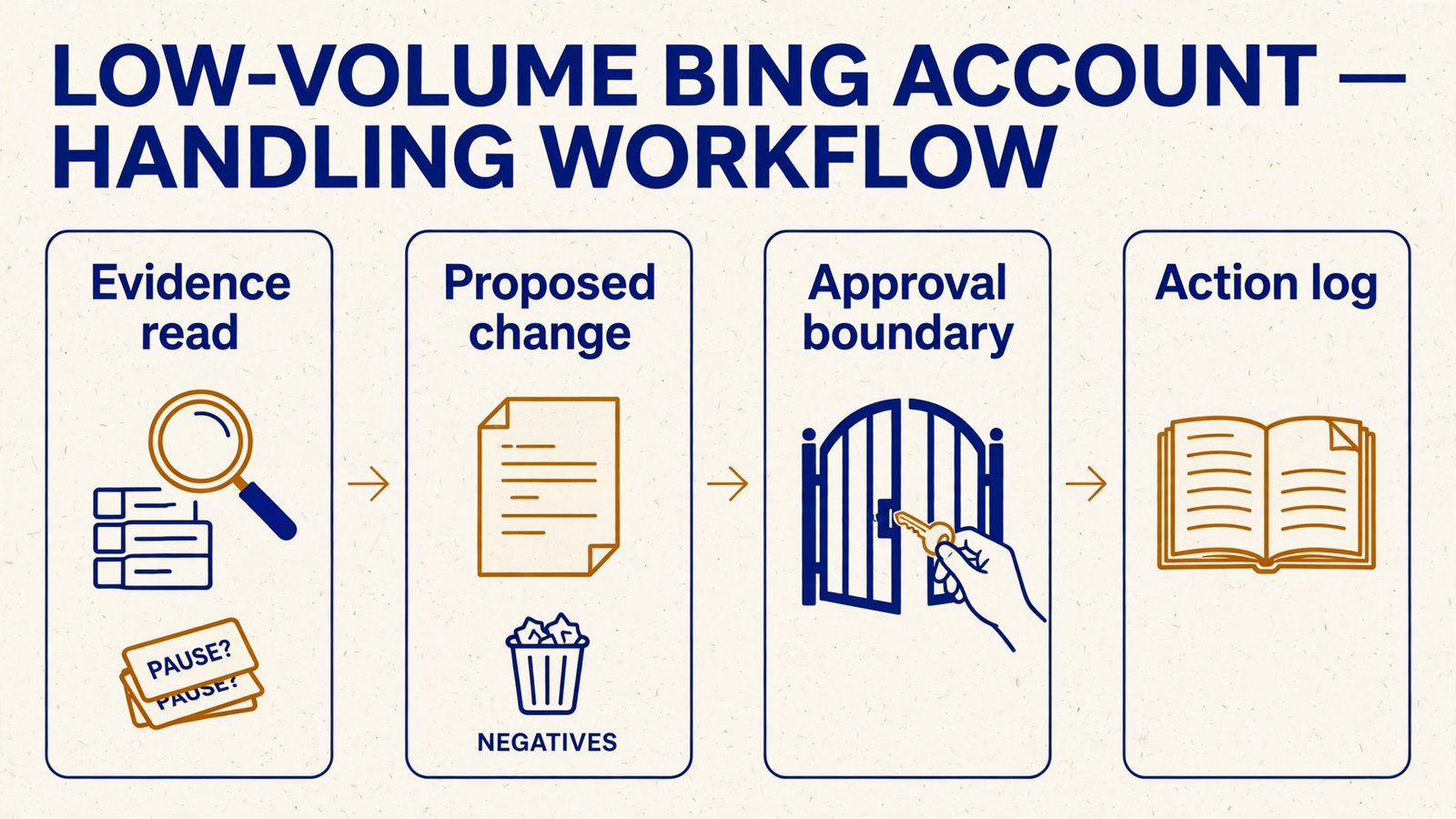
I want an operator’s notebook, not a victory lap. In this example, the review record might look like this:
Evidence: Bing, last 90 days. Three recorded conversions. UET firing on checkout only.
Proposed: Three exact-match negatives for queries outside the offer. Combined spend: $61.
Boundary: No keyword pauses. No bid changes. Proposals pending approval.
The record tells me what Claude saw, what it proposed, and what it left alone. I can check the queries against the offer and decide whether the exclusions hold up. The $61 tells me what those queries spent. It isn’t a savings figure, and I don’t need to pretend it is to justify looking at them.
If the log instead says “paused 12 keywords, saved $400,” I’ve built the thing I wanted to avoid. The pause is real. The savings claim assumes the clicks I didn’t buy would have produced nothing worth paying for. The account didn’t have the evidence to make that call before the pause, and a tidy number in the log doesn’t supply it afterward. I’d rather see two modest negatives and one honest “insufficient evidence” note. The first is management. The second is theatre.
So yes, I’d automate a Bing account with almost no conversions. Let Claude read the search terms, propose the negatives, and handle only the maintenance you’ve put under explicit rules. Keep one named strategist responsible for the performance calls until the account has enough evidence to make them. Sparse data is a reason to keep judgment human, not a reason to leave the account alone.





