

 LinkedIn

Your AI search share of voice can go up while the only buyers you can serve hear your competitor’s name. I’d take a lower score that tells me where I’m losing those buyers over a higher one that tells me I’m popular with everyone else.
I spent years running Google Ads for businesses that served a narrow slice of the market: a home-services company with a 90-mile service radius, a SaaS product that fit teams on one CRM, an ecommerce brand whose products worked with two hardware ecosystems and nothing else. The job wasn’t to get in front of more people. It was to show up when someone who could actually buy was choosing a vendor.
A blended AI visibility score can’t tell those situations apart. It tells me how often an assistant names a brand across a set of prompts somebody chose. If the new mentions all come from broad discovery answers, that number can climb while a rival owns the questions that decide purchases. Define who can buy, freeze those prompts, and judge progress there. Let the headline number look worse.
The category leaderboard is not your market
Take a hypothetical maker of pressure-washable control panels for food-processing lines. It sells only to integrators in DACH who build on one PLC family. It can’t ship to Ohio. It doesn’t sell to students researching what a control panel is. If a line runs on the wrong PLC family, there is no deal.
Run a standard visibility check: 100 industrial automation prompts, sampled weekly across ChatGPT, Perplexity, Gemini, and Google AI Overviews. The panel maker starts showing up alongside Siemens and Beckhoff in answers to “Which companies make industrial HMI panels?” The blended score goes up four points. Somebody puts it on a slide.
Look at where the new mentions land. One comes from a question a buyer might ask before picking a supplier, but the answer only names the panel maker. It doesn’t recommend it. The rest land in educational answers or broad category lists. The score went up. Recommendations to eligible buyers didn’t. If I use that score to decide what to publish next, I’ll pay for more of the work that made the slide look good.
The rival list can move the number even when the answers about your brand don’t change. In Citemuse’s worked example, a brand appears in 40 answers and scores 44% with two tracked rivals. Add a third rival that appears in 60 answers and the same 40 appearances now score 27%. Neither Google nor Microsoft publishes a brand-by-brand tally against which to check that figure. Before I ask what improved, I ask what went into the denominator.
Then I ask what got counted. Astiva’s taxonomy draws three useful lines:
- A mention names the brand.
- A citation credits one of its pages as a source.
- A recommendation puts the brand forward for a stated need.
These aren’t stages in a funnel. An answer can do any one of them without doing the others, and putting a brand first doesn’t make it a recommendation. In a Semrush study of 3,981 domain appearances across 115 prompts and four engines, 61.7% were ghost citations: the answer used the page as a source but never named the brand. Only 13.2% of appearances included both a citation and a mention. Add those signals together and the total can’t tell me whether the buyer even saw the company’s name.
For the panel maker, I want to know whether the assistant puts it forward for a washdown food line it can actually supply. I’ll track the other two signals, but I won’t give them credit for a recommendation they didn’t make.
Write down who can buy before Claude sorts the prompts
The fix starts with a document nobody wants to write: the eligibility brief. For the panel maker, it takes four lines:
- Sells only to integrators in DACH.
- Serves food-processing lines.
- Supports one PLC family. Anything else is incompatible, not underserved.
- Pressure-washable housing is the requirement that decides most deals.
Write those lines before touching the prompt list. Then give Claude the brief and ask it to classify each prompt as eligible, discovery-only, or uncertain. A DACH integrator asking for a pressure-washable HMI panel for a food line on the supported PLC family is eligible. “What is a control panel?” is discovery. “Industrial panel suppliers in Europe” is uncertain: it doesn’t tell me enough to know whether the panel maker can serve the buyer.
Keep uncertain prompts out of the eligible score. Review them separately instead of letting the model guess which buyers you can serve. A prompt that says “Siemens” but leaves the PLC family unspecified doesn’t get a pass just because it sounds technical.
Keep discovery in the report, too. I still read search-term reports for queries I’ll never bid on. Broad prompts can tell me what the market associates with the brand, and keeping them visible makes it clear I didn’t just delete the questions that made the numbers inconvenient. They get their own row, not a vote in the number I defend.
Freeze four things before the first sample
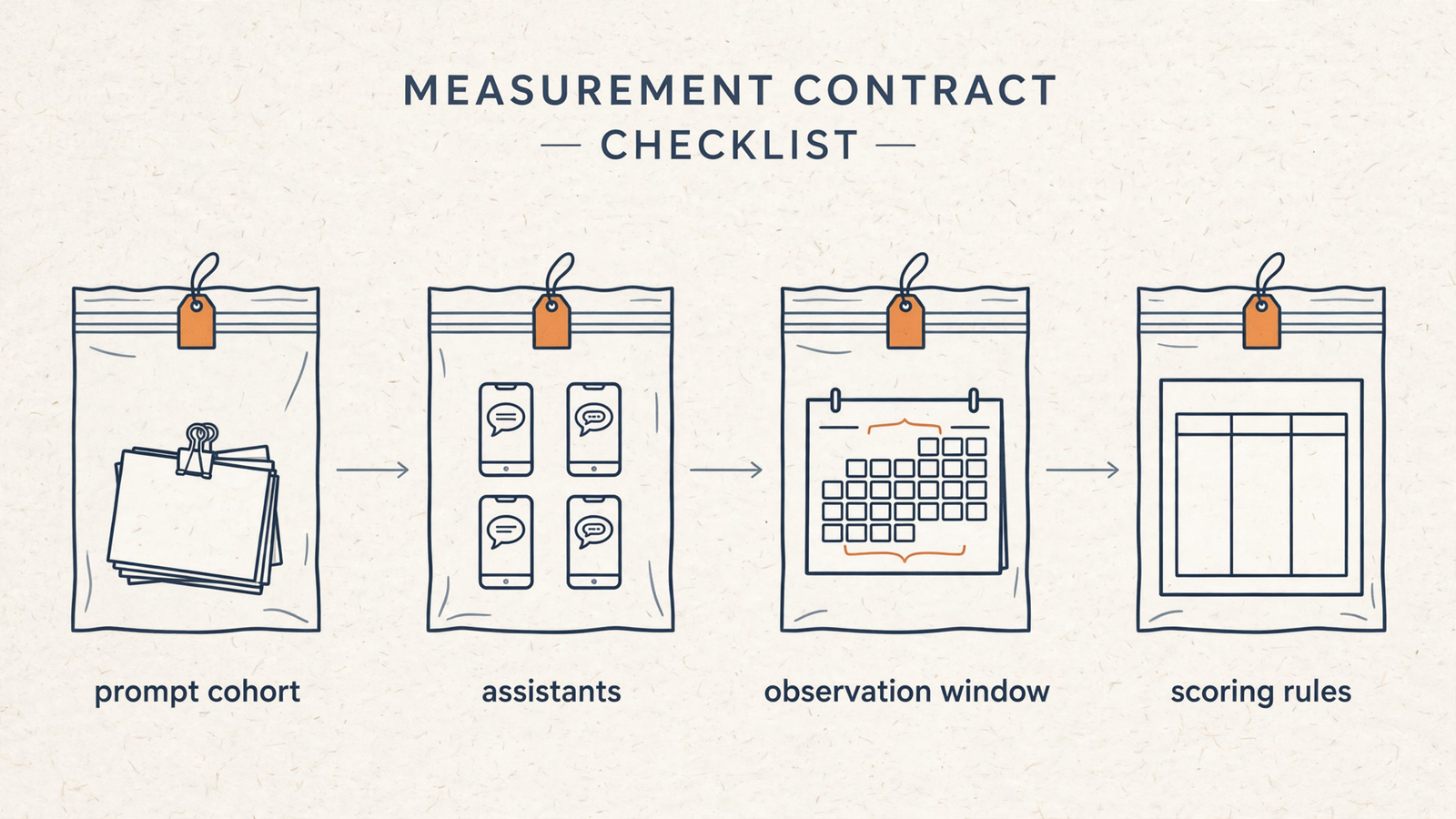
An eligible prompt list isn’t much use if it changes every time the score disappoints. I keep a written measurement contract in Claude so the rules sit next to the work. Freeze the denominator before the first sample, not when it’s time to put two quarters on a chart:
- Prompt cohort: Version the eligible list and keep the uncertain cases beside it, outside the score.
- Assistants: Keep ChatGPT, Perplexity, Gemini, and Google AI Overviews on separate rows. Don’t hide a change on one engine in an average across four.
- Observation window: Use the same window length when you recheck.
- Scoring rules: Record mentions, citations, and recommendations separately. Decide what qualifies before reading the answers.
The answers won’t repeat just because the prompts do. SparkToro and Gumshoe ran 12 recommendation prompts 2,961 times across ChatGPT, Claude, and Google AI. The same brand list came back fewer than one time in a hundred, and in the same order about one time in a thousand. Individual brands could still appear regularly: SmartSites showed up in 85 of 95 Google AI responses to one prompt, and City of Hope appeared in 69 of 71 ChatGPT responses to another. There’s a case for measuring appearance rates over repeated runs. “We rank third in AI” is a hallucination with a decimal point.
The category matters, too. In Search Engine Journal’s write-up of the study, tighter categories such as LA Volvo dealers or cloud computing showed 70–85% pairwise consistency; broad ones such as creative agencies fell below 15%. And when 142 people wrote their own versions of a headphone prompt, the wording varied widely, yet Bose, Sony, Sennheiser, and Apple still showed up in 55–77% of 994 responses. I’d rather freeze a set of questions that express real buyer needs than pretend one exact string represents the market. Run that set enough times to see a pattern.
Ask groas where eligible buyers get sent to rivals
Ask “Where is our share of voice lowest?” and you’ll get the biggest hole in the ground. If that hole is a discovery prompt where nobody buys, you’ve just given your writers a quarter’s worth of work with no reason to expect a sale. I ask for something narrower:
For this fixed cohort, show me where a competitor gets recommended and we’re absent. Include the full answer and the sources it cites.
That’s why I use Claude with groas connected instead of pasting screenshots into a spreadsheet. groas collects AI answers, competitors’ Google and Meta ads and the landing pages and funnels behind them, Reddit conversations, and SEO data from Semrush and Ahrefs. When a rival gets recommended to a buyer I can serve, I can read the answer and its sources, then look at what the rival actually puts in front of buyers. The funnel isn’t proof of why the assistant picked them. It’s evidence I can inspect instead of guessing from a score.
Start with the cited pages. If the answer relies on a rival’s spec sheet, check whether yours makes the relevant requirement as easy to verify. If it relies on a distributor directory that omits you, another 2,000 words on your own blog won’t fix the directory. One gap calls for better material on your site. The other calls for corroboration somewhere else. Read the pages before you decide which work to pay for.
Pay for approved work, not a chart that refreshes
A dashboard can refresh every Monday without changing a single page on your site. If the report is the deliverable, the website is still the same website. Buy inspection that leads to work someone approves.

I want three things from a package, in this order:
- Inspection. Run the fixed cohort, pull the answers where an eligible buyer is choosing, and read the cited pages. I do that in Claude with groas connected so I can inspect the answers and the competitor material in the same workflow.
- Work a person approves. Fix a spec sheet, make a comparison page, or correct a distributor listing that’s had your address wrong since 2023. Pick the job because of what a specific answer relied on, not because the content calendar had twelve slots. If you’re comparing packages, use the 12-point checklist for combined SEO and AI visibility before you sign.
- A boundary. Nobody selling the work can guarantee that ChatGPT or Gemini will cite your page. Google and Microsoft don’t publish their answer-selection rules. Buy a measurement you can repeat and work aimed at the gaps it finds, not a promise about what an assistant will say tomorrow.
groas Unlimited is $19 a month flat for a whole team: unlimited teammates, ad accounts, and websites, with every feature and the data groas collects around the clock. Agencies pay the same per client. That buys inspection and execution inside the AI you already use. The work is what you’re paying for. The assistant still gets to choose its answer.
Keep the uglier score if it tells you where you’re losing
Once the spec sheet is live or the distributor listing is fixed, run the same check again. Same prompts, same assistants, same window length, same scoring rules. Change the prompt list or add an engine and you’ve started a new baseline. Label it that way. Even on a fixed cohort, an engine can change its behavior: Search Engine Land describes how a ChatGPT update reduced outbound citations without brands necessarily becoming less relevant. A model release can wear a strategy costume if all you show is the line on the chart.
Report recommendation coverage and referral outcomes side by side. Don’t blend them.
- Coverage: Show where you’re recommended in the eligible cohort and where only rivals are. Keep mentions and citations in their own columns; neither is a recommendation.
- Observable outcomes: Show sessions from AI surfaces, inquiries, and deals where the buyer said an assistant sent them. One practitioner tracked thousands of AI answers over six weeks and recorded 26 visits from all AI platforms combined. An appearance isn’t a visit, and a visit isn’t a sale. The two sets of numbers aren’t supposed to reconcile.
Fix the gaps in two buyer situations where rivals get recommended and you don’t. In six weeks, recheck the same cohort against the same competitors. Give whoever signs the budget coverage and outcomes side by side instead of one blended score.
Skip that and here’s the buyer you won’t see on the dashboard: an integrator asks three assistants which vendor to use on a washdown food line. All three give the same two rival names. Yours never comes up. Your share of voice went up that quarter. So did your competitor’s order book.


