

 LinkedIn

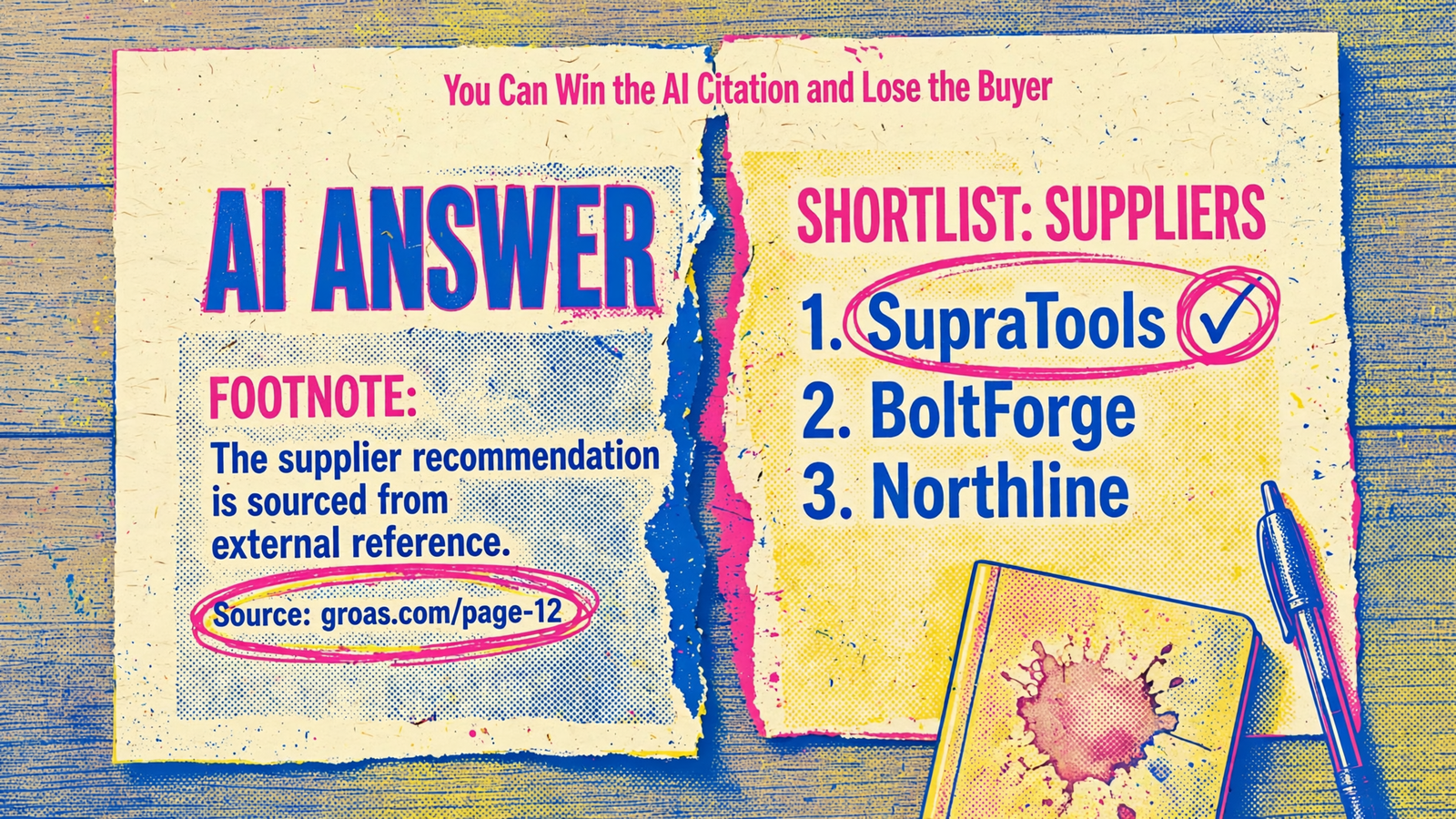
Winning the AI citation can still mean losing the buyer. Your page supplies the evidence. Your competitor gets the recommendation. Count both as “visibility” and a losing commercial position starts looking like progress.
Picture a commercial prompt where the answer quotes your pricing explanation, links it neatly in the footnotes, then names three suppliers to shortlist. You are not one of them. Your dashboard still logs that answer as coverage. That is the part I want in bold, not buried under a green percentage.
If you pay someone to manage how you show up across ChatGPT, Gemini and Perplexity, this distinction belongs at the center of the work. A blended visibility score lets a provider look better while your commercial position gets worse. I would rather see an ugly report that tells the truth.
Your page explains the category. Someone else fits the job.
Ask ChatGPT something a buyer would actually ask. Not “what is fleet tracking,” but “which fleet tracking supplier handles 40 vans in Austin with same-day install.” The answer has two jobs: explain the relevant facts, then name suppliers worth calling. Those jobs can draw on different material.
In that example, your page might be excellent at the first job. Clear pricing bands, a clean table, plain language the model can lift in one piece. So it lifts the explanation, cites you as source number three, and recommends someone else.
Why wouldn’t it? Suppose the competitor has comparison pages describing installs in Texas, review sites repeating that claim, and a pricing page matching the buyer’s constraint. You have the definition. The competitor has the evidence of fit.
Being useful to the answer is not the same as being suitable for the buyer. A citation records the first outcome. It does not establish the second. One tracking approach separates citation, mention and recommendation outcomes on the same prompt set, rather than blending them into one number. That separation is the only honest way to read this answer.
Stop combining four different events into one score
A single visibility percentage mashes together outcomes that fail for different reasons. I want four separate columns:
- Source citation: one of your pages was used as evidence.
- Brand mention: your name appeared in the answer.
- Shortlist inclusion: you were one of the suppliers named to consider.
- Accurate recommendation: you were named for a buyer whose stated constraints you actually fit.
You can win the first two and lose the last two on the same prompt. You can also get shortlisted for work you do not do. Counting that as a commercial win makes the report prettier, not more useful.
The split is not theoretical. One June 2026 analysis of observed AI citations found around 62% were ghost citations, where the brand gets named without its own site getting cited. Engines diverge hard here. Gemini named brands in about 83.7% of appearances but cited sources only about 21.4% of the time, while ChatGPT showed the reverse pattern and cited brands about 87% of the time.
Free tool: the AI Visibility Checker asks ChatGPT, Gemini, Claude, Perplexity and Grok the question your customers ask and shows whether they recommend you.
A provider that reports all of that as coverage is telling you the model talked about you. It is not telling you whether the model told the buyer to call you. Make the report distinguish appearance from selection. Otherwise, you cannot tell which problem you are paying to fix.
The cross-engine average can hide your most expensive loss
ChatGPT and Google do not agree nearly as often as a single score implies. In one test of tens of thousands of identical prompts, ChatGPT, AI Overviews and AI Mode gave different brand recommendations on 61.9% of queries, and only 17% returned the same brands on all three. A separate run of more than 160,000 prompts found only 3.8% of cited sources were shared by all four engines.
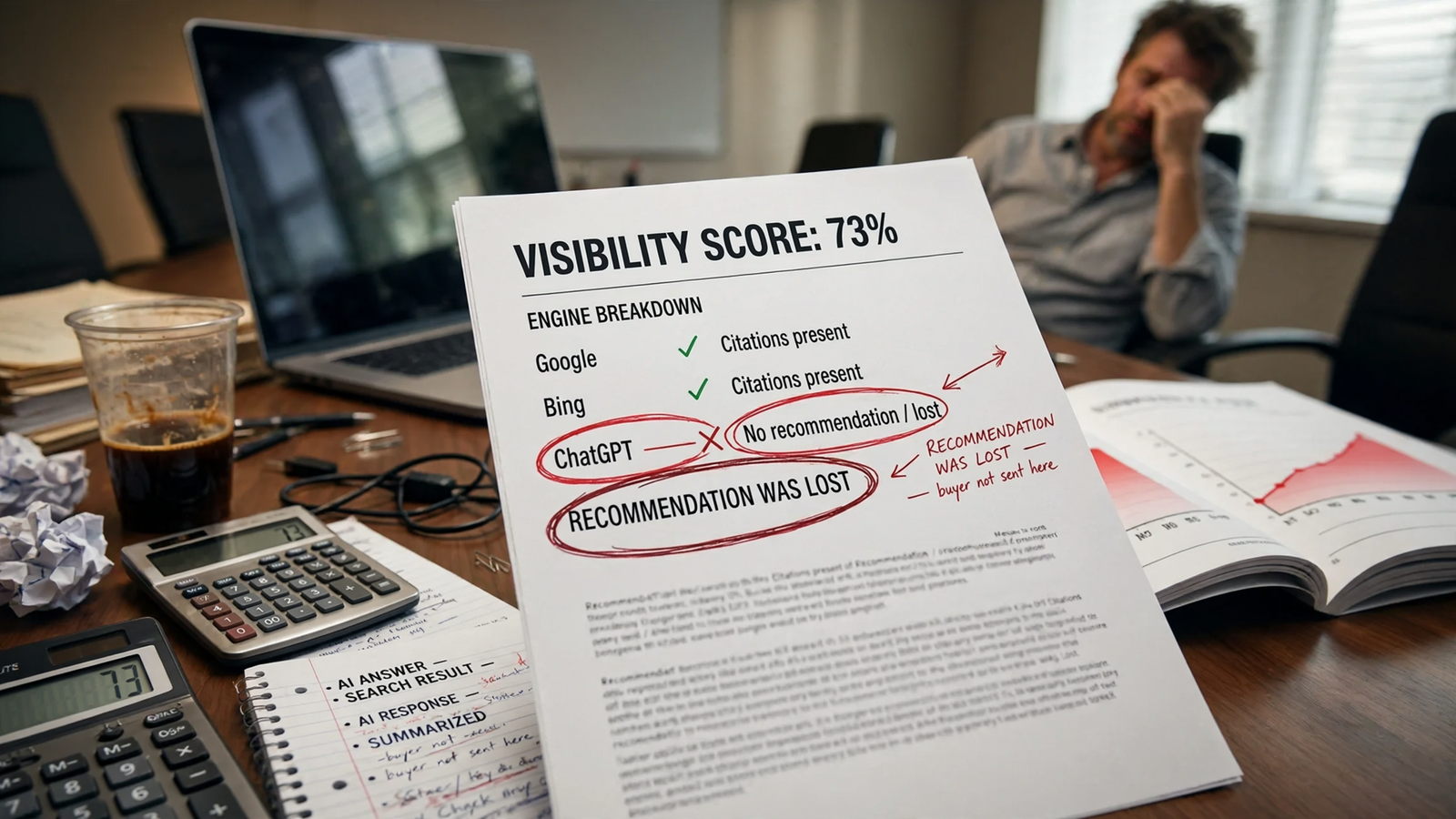
Say you score 70% visibility averaged across engines. That number can hide strong coverage in Perplexity, no appearances in AI Overviews, and lost buyer shortlists in ChatGPT. The average looks fine. The commercially important prompts do not.
I do not trust an average without its denominator. I want to know:
- Which prompts were tested?
- Which engines answered them?
- How many runs were recorded for each prompt and engine?
- Was web search on or off?
- How much did the results change between runs?
Run each prompt at least five times per engine and report the mean with the spread. In one B2B index, same-engine shortlist overlap was only about 43% on repeat runs, against 17% across engines. One observation is a sample. Five is the start of a pattern, not a guarantee that the next answer will match.
I keep a sheet of 60 buyer-prompt templates for this reason. It forces the test onto questions a buyer would pay to answer, not definitions your blog already covers.
If a report will not show per-engine, per-prompt results with the counts behind them, it is a brochure. Do not commission work from the headline alone.
Commission the fix for the outcome you are missing
The point of separating outcomes is not to build a more elaborate dashboard. It is to stop buying the wrong work.
Start with access. No content fix matters if the model cannot fetch the page. Sites that opt out of OAI-SearchBot will not appear in ChatGPT search answers, though they can still appear as plain navigational links. Robots.txt changes take about 24 hours to apply.
Free tool: the AI Crawler Checker shows which AI crawlers your robots.txt lets in and what they receive when they arrive.
I check access before proposing a content sprint: server logs, crawler blocks, and whether GPTBot and OAI-SearchBot were disallowed together when the intention was only to block training. Allowing OAI-SearchBot while keeping GPTBot disallowed permits search visibility without opting into training. Fix access before rewriting pages nobody can retrieve.
Once access is clear, inspect what the page actually answers. High Google rank does not buy the citation. In BrightEdge tracking from September 2025 to February 2026, only about 16.7% of AI Overview citations came from the organic top 10, with about 54.5% ranking somewhere in the top 100. Conductor found position one cited 24.9% of the time against 10.2% for position ten.
Those numbers are not permission to ignore rank. They are a reason not to mistake it for selection. For the fleet-tracking prompt, I want the buyer page to answer the actual constraints in one place: service area, minimums, install time, price band, and who the offer fits. A definition of fleet tracking does not answer whether you can handle 40 vans in Austin.
My rule: if your page cannot answer the last half of the prompt, do not treat its citation as proof that it deserves the recommendation.
Then comes the part most content advice skips: your own pages are not the only evidence in the answer. Across analyses of millions of AI citations, 84 to 85.5% came from earned media against 0.3% from paid, and unlinked brand mentions correlated at 0.664 with AI visibility against 0.218 for backlinks. In one sample, 66% of ChatGPT recommendations named a brand without citing that brand’s own site.
The distinction matters. Your page can state what you do; third-party material can corroborate it. Those figures do not turn every mention into a guaranteed recommendation. They do make “publish more on our own blog” a poor automatic response to losing shortlists.
I commission the work backward from the missing outcome:
- Nothing can be fetched: fix access and rendering.
- Commercial prompts retrieve definitions but no useful supplier information: rewrite buyer pages around the stated constraints.
- The brand is accessible and clearly described but still misses shortlists: work on third-party corroboration of that fit.
Each assignment addresses a different failure. A generic publishing sprint treats them as the same problem because publishing is what the provider already sells. That is a convenient operating model for the provider. It is not a diagnosis.
Demand the answer, the shortlist and the cost of an honest report
If you are choosing someone to manage your presence across ChatGPT, Gemini and Perplexity, ask to see one real answer before signing anything. Not a score. The answer text, its cited sources and its named suppliers, side by side.
That layout makes the failure visible in seconds. Your URL sits in the footnotes. A competitor sits in the shortlist. Nobody gets to call that a recommendation win.
I wrote down seven questions I use to check whether ChatGPT actually recommends a business for this test, because reports too often answer whether you appeared and skip whether you were picked.
That is the first requirement. The next two determine whether the report can guide commercial decisions rather than decorate a monthly call.
Connect recommendations to enquiries without pretending attribution is perfect
Citations do not book calls by themselves. Shortlists sometimes lead to them. I want to track which prompts produce a named recommendation and whether branded search or direct enquiries move in the same weeks, where measurement permits.
That is imperfect. I would say so in the report. Movement in the same period is not a clean account of which answer produced which enquiry. But it still beats presenting a 73% visibility average while the sales team keeps hearing competitor names on discovery calls.
The cost of honest reporting is a worse-looking headline and a less comfortable conversation. You separate citations from recommendations. You show the gaps. You acknowledge what the enquiry data cannot establish. A provider willing to do that gives you something useful to manage, rather than something pleasant to forward.
Reject guaranteed placement, even when the pitch sounds precise
I reject guarantees of a citation, a mention or a recommendation. No agency or tool can promise ChatGPT, Gemini, Claude or Perplexity will cite a site, because the assistants’ source choices shift with the model, the wording and the moment.
Google has said for years that nobody can guarantee the top ranking. The same limit applies to promises about AI answers. A vendor guaranteeing placement is telling you how it sells, not how the models work.
A good page can earn eligibility. It cannot earn a promise. Pay for accountable work on the missing outcome, not a guarantee that somebody else controls the answer.
The work matters more than the score that records it
That is the standard I hold any managed program to, including groas. If I pay for management across ChatGPT, Gemini and Perplexity, I want the ugly split on the page: this prompt cites us, this one names us, this one shortlists us, this one recommends the competitor. Each outcome gets counted per engine, with the runs shown.
Then I want the work assigned to the gap, not a publishing quota. Separating outcomes costs more attention than reading one percentage. It also forces a decision: fix access, improve buyer-fit information, or build corroboration. You cannot hide all three behind “more content.”
I wrote about why ChatGPT can cite a site and still recommend someone else because that missing recommendation can expose a buyer-page or corroboration failure. groas pairs continuous execution with a named strategist who owns the response, rather than leaving the client to interpret a monthly PDF of blended scores.
Execution assigned to the missing outcome is the product. The score is the receipt. A managed program should make that distinction visible even when it makes its headline results look worse.
Keep buying the blended number and the failure stays hidden. Your citations climb. Your reports turn green. Your competitor takes the shortlist on the ten prompts with a budget behind them. You find out later on discovery calls, when prospects say they already spoke to someone else first.
A citation without a recommendation can become someone else’s sales enablement: written by you, hosted by you, paid for by you. Demand the split, or keep funding it.
On Monday, pull ten prompts your buyers would pay to answer. Run each at least five times in ChatGPT, AI Overviews and Perplexity. Mark four columns for every answer: cited, mentioned, shortlisted, recommended for the stated constraint. Keep the engines separate and record the variation. The column with the zeros tells you what to commission next. Keep that sheet next to the blended report, because the sheet decides the work. The report only records it.


