LinkedIn

509 impressions. Zero clicks, and not a shred of evidence in those rows that AI Overviews took the traffic. The three queries averaged positions of 18.3, 22.2, and 26.8. I’d inspect the ranking pages before I spent next season’s budget on an explanation the data can’t support.
The tempting story writes itself: Google answered the question, so nobody clicked. An AI search tool can make that sound like a finding by putting a visibility chart next to the click data. But putting the two next to each other doesn’t establish what searchers saw. It gives you a plot, not an explanation.
The three Search Console rows behind the 509 impressions
| Query | Impressions | Clicks | Observed CTR | Average position |
|---|---|---|---|---|
ai overview tool | 227 | 0 | 0% | 18.3 |
ai overviews tools | 158 | 0 | 0% | 22.2 |
ai overviews tool | 124 | 0 | 0% | 26.8 |
| Total for these rows | 509 | 0 | 0% | — |
The figures come from the supplied Search Console observations for one site. The total is the sum of the three rows, not market volume, a count of unique people, or a sitewide total. The observed click-through rate is zero clicks divided by 509 impressions. Zero is the result for these rows, not an estimate of what happens on every search for these terms.
Google’s explanation of Search Console performance data gives the figures their boundaries: an impression records exposure on Google results, a click records a click from those results to the property, and average position isn’t the rank every searcher saw. Google also notes that privacy filtering can hide anonymized queries from the table while including them in chart totals. I’m adding up the rows I have, not trying to reconstruct a report I don’t.
The reporting period isn’t supplied, either. I can compare the rows as given. I can’t compare them with last quarter, call them a trend, or blame the season. Before I ask why nobody clicked, I want to know where the property showed up. The average positions make that a better first question than whether Google answered for it.
Let Claude do the arithmetic, not the attribution
I’d put the table into Claude and ask for the arithmetic first:
Reproduce this table, calculate observed CTR, and separate observations from hypotheses. Do not attribute missing clicks to AI Overviews.
Claude can add the impressions, calculate the observed CTR, and point out that even the best average position in the table is outside the top ten. What it can’t do is turn an average into a replay of the results page. As Practical Ecommerce’s explanation of average position notes, search features can affect position, and what appears can vary with device and personalization. An average of 18.3 could reflect appearances clustered around that position or a mix of higher and lower appearances. The row doesn’t tell me which.
Weak average positions are compatible with zero clicks. They don’t establish why there were zero clicks. That distinction holds even when research gives me a good reason to take AI Overviews seriously. A 2026 field experiment on AI Overviews found that when they appeared, outbound organic clicks fell by 39.8% and zero-click searches rose by 34.5%. That’s evidence from the experiment, not evidence that an Overview appeared for these queries, that the site was cited, or that a searcher saw an answer and decided not to click.
I used to make that leap in client decks. I stopped. It felt like insight because the direction was plausible. Plausible is not measured. I’d keep the study as a reason to investigate, not paste its result into the diagnosis.
Keep search exposure, AI citations, and visits separate
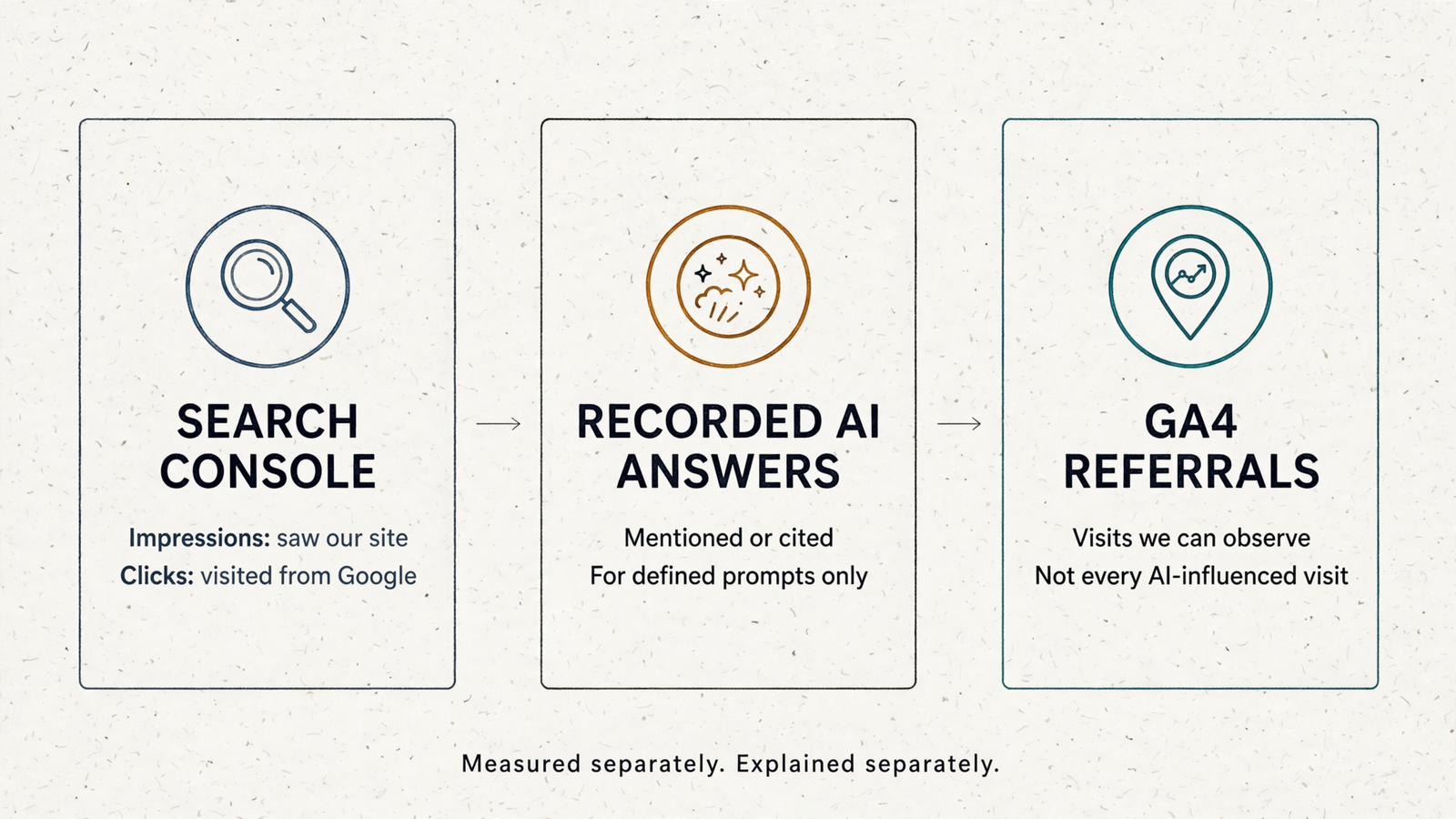
One workflow doesn’t mean one metric. I want these measurements in the same place so I can compare them, not so I can average away their differences:
| Measurement | What I can say | What I can’t say |
|---|---|---|
| Search Console impressions and clicks | The property appeared in Google results and recorded the clicks shown for the query. | A particular searcher saw an AI answer or skipped the site because of it. |
| Recorded AI answers | A captured answer mentioned or recommended a brand, or cited a particular URL. | Every user asking that question saw the same answer, or the citation sent a visit. |
| GA4 referrals | A session was recorded and attributed to a source. | The report captures every visit from AI, or an AI answer caused the visit. |
Each measurement has a different blind spot. The discussion of Search Console’s generative AI report highlights the problem with treating page-level AI impressions as a verdict on the work: the feature itself can roll out more widely. With recorded answers, the problem is sampling. Citelity’s citation-tracking example puts a roughly 40–89% interval at the 95% confidence level around 7 citations in 10 runs. The useful part of that example is how wide the interval is. I wouldn’t turn a handful of captures into a precise visibility score.
With GA4, the problem is classification. In Usermaven’s tests of AI traffic in GA4, ChatGPT links landed in Unassigned, Perplexity in Referral, and Google AI Mode in Organic Search. That’s what those tests found, not a rule for identifying which Unassigned sessions came from ChatGPT. A report can miss AI traffic without giving me a reliable way to count what it missed.
This is why I’d connect Search Console, GA4, and AI visibility data to Claude through groas. groas supplies the data; Claude can bring the search rows, recorded answers, and sessions into one chat without merging them. I’d keep the source, date range, and sampling scope attached to each. The useful output isn’t a prettier chart. It’s being able to point to the record behind each claim.
Ask for the missing evidence before writing the explanation
The remaining supplied observation reads Is there one tool that covers SEO and AI visibility together? It’s labeled ai_prompt, not a Search Console query. It’s a buyer question I can look for in recorded assistant answers. It isn’t another row of Google impressions, and the label alone doesn’t tell me what any assistant said.
So my next prompt is about what the search table leaves out:
For these buyer questions, show the recorded AI answers, engines, capture dates, cited URLs, and competitors mentioned. Mark anything we have not measured.
If there’s no record of whether an AI Overview appeared for ai overview tool, whether it cited the site, or which competitors it recommended, I want the tool to say so. Not measured is a useful result. Not cited is a different result, and it needs an answer I can inspect. I’d rather have a list of gaps than a paragraph that quietly turns them into findings.
Semrush’s prompt-tracking methodology is useful on this point: coverage gaps, answers that vary from run to run, and platform changes all affect what a tracking report can say. I want to know what the tracked prompt set covers. I also want the report to distinguish a brand name in the answer from a link to one of its pages. Masa School’s summary of AI visibility definitions describes the former as a mention and the latter as a citation. I wouldn’t pay to fix a citation gap on the strength of a mention count.
Even a recorded citation doesn’t settle attribution. In Seer Interactive’s study of 3,119 queries, queries where the site was cited in an AI Overview had 35% more organic clicks than queries where it wasn’t cited in the Overview. Seer warns that stronger brands may be both more likely to earn a citation and more likely to get clicks. I’d use the captured answer to see which source the assistant cited, not use the difference in clicks to promise a return on earning that citation.
Inspect the ranking pages before funding citation work
On the evidence in the table, I’d spend the first afternoon on the ranking pages, not on an AI visibility retainer. Start with ai overview tool. Does the page that surfaces for that query answer the buyer question behind it, or does it answer a neighboring one? I don’t know from the row. I do know the row gives me a specific page-and-query relationship to inspect before I spend money on the AI Overview theory.

- Check search intent first. Inspect the pages behind the three queries. If a page answers the wrong question, tie the proposed edit to the query that makes the mismatch visible. Don’t turn the average position into a diagnosis of the page before looking at it.
- Inspect competitor citations only where they’re recorded. I want the answer, prompt, engine, capture date, and cited URL before I ask anyone to write against a competitor’s page. If those records don’t exist yet, the next job is measurement, not a content brief.
- Keep separate success criteria. When I can see both weak search rankings and competitor citations, I track search clicks and sampled citations separately. A revision can move positions without moving citations. Reporting one as progress on the other is how a chart ends up doing more work than the page.
When I compare tools, I look for recorded answers and citations, not just a visibility chart. I also want the workflow to carry a justified change through review and publishing. The deliverable is one evidence-linked page revision or one new-page brief. Not a deck. Not a score with a footnote. If Claude can’t point to the search row or recorded answer that justifies the change, it doesn’t ship.
Make one reviewed change, then measure like for like
With groas, I’d publish after review and keep the change log. Each change is logged with its reason and can be undone in one step. Once the page changes, that record tells me what I actually tested. A separate audit of 722 impressions and one click makes the same distinction: keep AI Overview tracking separate from assistant visibility before acting, or the follow-up won’t tell you which measurement moved.
Recheck the same query groups and the same prompt sets. Use comparable reporting windows, and say when the season or sampling changes. If I switch prompts or engines, I can report what the new sample shows. I can’t call the difference a lift. And since these supplied search rows have no reporting period attached, I wouldn’t use them as a dated baseline for the revision. I’d establish that baseline before publishing.
So, is there one tool that covers SEO and AI visibility together? Yes. That was never the hard part. The hard part is keeping the measurements honest when they disagree. My test for any vendor, including us: show me the prompt set, show me the capture dates, and show me which claims you won’t make. A combined workflow earns its place by keeping the evidence visible, not by fitting it all into one score.
For the rows that started this, the budget decision is narrow. Inspect the ranking pages for intent fit first. Measure the buyer prompts separately before funding citation work. When the evidence supports a change, publish one reviewed revision, log it, and recheck like for like. No promise of a top-ten ranking. No story about stolen clicks. Fund the work the numbers support.