

 LinkedIn

A 0.14% click-through rate is a lousy return, but it is not a diagnosis. Five supplied Search Console queries produced 722 impressions and one click; none of those figures tells me whether ChatGPT recommends the site.
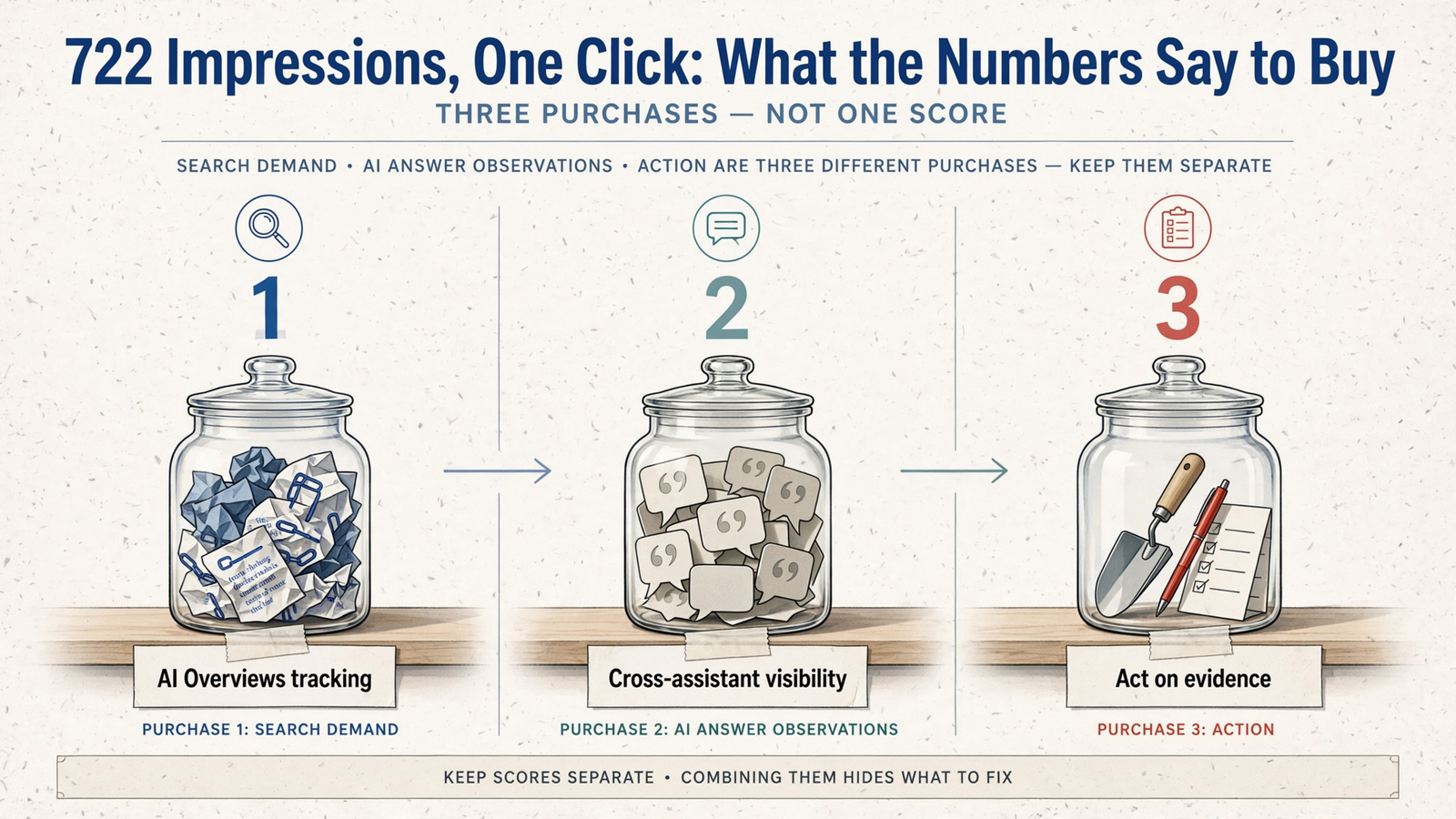
That distinction decides what to buy. An AI Overview tracker, a cross-assistant visibility tool and an operational connection answer different questions. Buy the wrong one and the dashboard gets busier while the problem stays put.
Here is the entire supplied dataset:
| Query | Impressions | Clicks | Average position |
|---|---|---|---|
| ai overview tool | 227 | 0 | 18.3 |
| ai overviews tools | 158 | 0 | 22.2 |
| ai overviews tool | 124 | 0 | 26.8 |
| best aeo tracking software | 142 | 0 | 66.6 |
| ai visibility dashboard | 71 | 1 | 14.6 |
| Total: five selected rows | 722 | 1 | Not aggregated |
Source: the supplied Search Console rows. No date range or source URL was supplied; this is the full dataset available for this audit.
Aggregate CTR is one divided by 722, or about 0.14%. These are selected rows, not a market sample or a full quarter of demand. They establish that the site appeared for tool-selection searches and earned almost no clicks from this slice.
They do not establish a citation problem. Before spending anything, I would separate the evidence of weak Google search performance from the missing evidence about AI answers.
What the 0.14% CTR does—and does not—explain
Every query in the supplied table has an average position worse than 14. The weakest averages 66.6. Low visibility in Google’s results is an obvious place to start investigating the poor click-through rate.
It is not, however, a complete explanation. Average position is not a fixed slot, and these rows do not show which result layouts appeared, what the snippets said or whether an AI Overview was present. Calling the CTR fully explained would turn a plausible diagnosis into a finding the file cannot support.
For context, a published CTR discussion reports that the first organic result takes about a quarter of clicks, while fewer than 1% click anything on page two. The same source reports a 58% CTR decline when an AI Overview appears. Those figures explain why position and result layout deserve attention. They do not tell me which mechanism affected these particular impressions.
The other boundary is more important: Search Console does not report ChatGPT or Perplexity recommendations, and AI Overview activity is folded into organic reporting rather than separated into a citation report.
A weak Search Console row is evidence about Google search performance, not a verdict on assistant visibility. I would investigate ranking and relevance here. I would not label the site absent from AI answers without checking those answers.
Ask Claude to separate the three purchases
A column called AI visibility can hide several incompatible measurements. Before asking Claude to interpret it, I would split the job with this prompt:
Classify these queries into Google AI Overviews tracking, cross-assistant visibility, and reporting or action. Keep ambiguous classifications explicit. Do not infer assistant citations from Search Console clicks.
The categories matter because each buys a different answer:
| Purchase | Question it should answer | What it does not establish |
|---|---|---|
| Google AI Overview tracking | Does the site appear inside Google’s AI answer for the observed queries? | Whether other assistants recommend it |
| Cross-assistant visibility | Do ChatGPT, Perplexity and Gemini mention, cite or recommend it on the tested prompts? | Whether those answers produce visits or business results |
| Reporting and action | What evidence supports a change, and how does that change get made? | That the change will improve rankings or citations |
AI Overview trackers vary in detection method, with listed prices ranging from $29 to $399 per month. Some use proprietary databases, some browser sessions and some API prompts. The method determines what gets observed, so it belongs beside the score—not buried beneath it.
Cross-assistant AEO software lists prompt tracking, citation analysis, competitor benchmarking and content recommendations. That is a different measurement job from detecting Google’s answer box.
Choose the question before choosing the tool. For a query averaging position 66.6 in the supplied rows, another visibility score is not a substitute for investigating the page’s ranking problem.
Join the evidence without blending the scores
Claude is useful here as an analyst, not as permission to merge unrelated numbers. I would ask it to keep Search Console, observed AI answers and GA4 referrals in separate tables until the question requires a comparison.
Search Console shows whether Google displayed the page for these queries. AI-answer observations show whether assistants named or cited it on tested prompts. GA4 shows attributed visits and what happened after arrival. Each uses a different denominator.
| Evidence source | Question it answers | Context to print with the result |
|---|---|---|
| Supplied Search Console rows | Did Google show the page for these tool queries? | Five selected rows; 722 impressions; one click; date range not supplied |
| groas AI search data via Claude | Did assistants mention, cite or recommend the site in observed answers? | Prompts tested, answers checked, assistants and dates |
| GA4 referrals | Did identifiable AI referrals bring visits that did anything? | Sessions by source, date range and attribution limits |
Visibility tools can disagree because they sample different questions, engines, locations, answer counts, dates and definitions of visibility. A score moving between two dashboards may reflect the measurement setup rather than a change in the site’s visibility.
Keep the source, date range and denominator attached to every result. If the date range is missing, print “not supplied.” A blank is more useful than invented precision.
GA4 referrals are a floor, not a count of every mention
GA4 catches some AI visits through referral sources such as chatgpt.com, perplexity.ai, claude.ai and gemini.google.com. Those visits can sit inside Referral unless a custom AI channel separates them.
But app clicks and clicks without a referrer can appear as Direct, while brand mentions may produce no visit at all. Identified AI referrals are a floor, not a ceiling. They are useful evidence of visits, not a census of AI influence.
The single click in the supplied Search Console table is a Google search click. It is not an AI referral count, and the file does not establish a corresponding GA4 session. Keeping that distinction straight prevents a surprisingly easy reporting mistake: giving the same number several incompatible jobs.

When I ask Claude to join these evidence streams, my rule is simple: no denominator, no slide. groas collects competitor ads, landing pages, Reddit discussions and AI-answer data around the clock. Connecting groas to Claude gives the model evidence to investigate rather than another score to repeat.
The connection is valuable only if the questions stay separate.
Buy the missing evidence, not another dashboard
The buying question is not “Which AI visibility tool is best?” It is “Which unanswered question blocks the next decision?”
For these rows, I would use this order:
- Need to observe Google’s answer box? Choose AI Overview tracking. Overviews vary, do not appear consistently and can contain multiple cited sources. Ask how the tool detects them before interpreting its coverage.
- Need to observe assistant recommendations? Choose cross-assistant measurement. Prompt tracking and citation analysis across assistants address that gap. One assistant’s answer is a sample, not a verdict.
- Already have evidence but cannot turn it into a change? Choose the operational connection. More monitoring will not resolve a stalled investigation, draft or approval.
These are separate jobs, even when one product covers more than one. A tracker can tell me what it observed. I still need to decide whether the observation warrants a page change.
The operational job is why I would route this audit through Claude with groas rather than stop at a single-purpose dashboard. The workflow can bring the search evidence, observed AI answers and referral checks into the investigation, then move from diagnosis to a proposed fix. Changes through groas are logged and can be undone in one step.
groas Unlimited costs $19 a month, flat, for unlimited teammates, ad accounts and websites. That is below the lowest listed monthly price in the AI Overview tracker comparison above. Price alone does not make two measurements equivalent, but it makes the operational connection the stronger starting purchase for this audit: the immediate task is to investigate and act, not collect another unexplained score.
Buy a dedicated measurement tool when its observations answer a question the current evidence cannot. Do not buy one merely because the CTR looks ugly.
Turn the strongest lead into one approved action
The highest-impression query is not automatically the best first task. In the supplied rows, ai overview tool has 227 impressions at average position 18.3. ai visibility dashboard has fewer impressions—71—but a better average position, 14.6, and the only click.
I would investigate the dashboard query first. That is a prioritization choice, not proof that it will be the easiest win. Its position makes it a more plausible near-term candidate than best aeo tracking software, which averages 66.6. The table alone does not tell me whether the page needs a title adjustment, a deeper rewrite or a different treatment altogether.
Calling the latter query a confirmed content gap would go too far. Calling a snippet tweak the obvious answer would go too far too. I need the page and its search intent in front of me before prescribing either.
For the broader workflow, I would turn the SEO audit into prioritized fixes in Claude, then narrow the work to one decision. The prompt can stay deliberately boring:
Show the evidence for the highest-priority gap. Recommend one page change, explain the uncertainty and wait for approval before publishing.
I would require the response to include:
- The evidence. Show the relevant query and page, with source, date range and denominator. Flag the missing date range in this supplied file.
- One proposed change. For example, align the title and opening section with tool-selection intent rather than a generic AI overview explanation—but only if inspecting the page supports that diagnosis.
- The uncertainty. State what remains unknown, including the number of assistant answers checked and whether an AI Overview appeared during observation.
Nothing publishes without approval in this workflow. groas autopilot stays off until switched on; changes are logged with their reasons and can be undone in one step. Automation should remove the mechanical work, not quietly replace the decision.
I would schedule a follow-up after 30 days and check the same queries, prompts and GA4 referral definitions. That is a proposed review interval, not a promise that rankings or citations will move within it. Comparable measurements matter more than a fresh dashboard screenshot.
A ranking improvement would be evidence about search performance. A new ChatGPT citation would be separate evidence. And a citation is not the same outcome as a recommendation. Keep all of them; do not rename one as another.
The buying verdict: act on the ranking evidence first
These rows support a ranking investigation before a tracker purchase. They do not prove that position explains every missed click, and they say nothing conclusive about assistant citations. That is enough to make a useful decision without pretending the file contains more than it does.
The related audit of our own Search Console data is another place to examine the impressions-versus-clicks problem. It is not a replacement for observing AI answers. Neither analysis can manufacture assistant visibility data from a Google click total.
I would start with groas connected to Claude, investigate the dashboard query and approve one evidence-backed change. groas already collects AI answers, competitor ads and SEO data around the clock, so I would use that evidence before adding a separate subscription.
If the investigation exposes a need for more specific Google AI Overview observations, then the detection method becomes the buying criterion. If it exposes unanswered questions about ChatGPT or Perplexity recommendations, then cross-assistant coverage becomes the criterion. Neither purchase needs an invented citation crisis to justify it.
The next step is concrete: export the supplied rows, preserve their source and missing date range, and label every subsequent score by the question it answers. Investigate ranking and relevance for the dashboard query first. Measure citations separately. Buy another tool only when the missing evidence blocks a decision. That order is the entire audit.


