LinkedIn

A higher AI search visibility score can mean the vendor asked easier questions. I won’t buy a package on that number unless I can see the prompts, competitors, and answer surfaces behind it and use my AI to find a gap worth fixing on that same set of questions.
Share of voice is a fraction. Change the questions, change which competitors count, or swap mentions for citations, and the fraction can move even if the brand’s presence in ChatGPT or Claude hasn’t budged. That’s the part the sales deck skips. Before I ask how high the number is, I ask what went into it.
A bigger score can mean easier questions
Say one vendor tracks 12 questions a brand already shows up for. Another tracks 100, including questions where competitors get cited and the brand doesn’t. I’d expect the first vendor to hand me the prettier score. That tells me which set of questions was easier, not which package gives me a better read on visibility. The second package may be showing me exactly the gaps I’m paying to find. I wouldn’t give it extra credit just for tracking 100 questions, either. If the extra questions aren’t ones buyers ask when deciding what to buy, I’m looking at a longer list, not necessarily a better one.
The same answers can produce different headlines, too. In one MentionScout comparison, the same 48 ChatGPT answers yielded 85% share of answers but 24% share of mentions. Those numbers don’t contradict each other. They count different things. Profound’s documentation spells out the distinction in its own metrics: visibility score divides responses that include the brand by responses that include at least one brand. Share of voice divides the brand’s mentions by all brand mentions. A citation points to a specific page.
I don’t need every vendor to use the same formula. I need to know which formula I’m looking at and which answers went into it. If I can’t fix the prompt set before buying share-of-voice tracking, I can put the number in a board deck. I just can’t tell what to do about it Monday morning.
Get the prompt list before the dashboard tour
When I compare two or three packages, I ask for the questions, the coverage, and the counting rule. Then I ask to see the answers. That’s where a tidy explanation either holds up or doesn’t.
- Which buyer questions are included? I want the actual prompt list, including commercially relevant questions where the brand doesn’t show up.
- Where and when did the vendor run them? I want the assistants, markets, observation dates, and competitors represented in the score.
- What counts? I want to know whether I’m looking at mentions, recommendations, or citations, and whether the vendor combines them.
If I get a paragraph explaining the score but no underlying answers, I treat it as marketing copy. If I get the answers but can’t choose the questions I need to follow, I treat it as monitoring software. It can tell me what happened on its panel. It can’t run the workflow I’m buying it for.
The competitor list alone can change the readout. In an Airanklab example, counting only four chosen brands rather than every brand the AI named moved share of voice from 17.5% to 22.6%. A brand can also appear in every answer and still get just 20% share of voice if each answer names it and four other brands once apiece. That’s the difference between showing up and accounting for a share of what shows up.
Weighting changes the picture again. In an Ahrefs example, weighting by search volume took a brand from 67% basic share of voice to 31% because its mentions came on lower-volume prompts. Ahrefs also warns that rolling assistants into one score can hide weakness on an individual engine. And the difference between a mention, a recommendation, and a citation isn’t a glossary exercise. A brand name in a list, a recommendation in prose, and a reference to a specific page tell me three different things. I won’t pay a vendor to blend them and make me guess which one moved.
Ask Claude to show the answers behind the score
A percentage I can’t interrogate is a press release. With my accounts and website connected, I use groas with Claude over MCP and ask to see the work. groas collects AI search answers and SEO data from Semrush and Ahrefs around the clock, and my AI can query that data in plain English. The summary is the least useful part. I want the answers the summary came from.
Show the tracked prompts, observed answers, citations, and competitor mentions behind our share of voice. Flag missing observations and ambiguous brand matches. Do not combine unlike measures.
I want Claude to show me where a brand was named, where a page was cited, and where there’s no observation to inspect. A missing answer stays missing. It’s not the same as an answer that leaves the brand out. An ambiguous match gets flagged, not counted on the strength of a familiar-looking name. And when I read the answer itself, I can see how the assistant described the brand, not just whether the name appeared.
I keep those answers for the next comparison. If the vendor will show me today’s summary but not the answers behind it, I stop there. The next chart won’t make the first one easier to explain.
Give every package the same test, then price the work
Here’s the question I put to every shortlisted package: Can my AI show me a commercially relevant prompt where a competitor gets cited and we don’t, then propose what to publish or fix? I want the prompt, the observed answer, the cited competitor page, any existing page of ours that addresses the question, and a draft I can approve. A chart and a quarterly call don’t pass.
I use the same prompt set for every package, and I want enough breadth that one question doesn’t carry the verdict. In 10,826 measurement series, Sistrix found that for a brand present in 25% of answers, one prompt repeated for 20 days could yield a measured rate anywhere from 0% to 59%, while 100 prompts yielded 21% to 29%. Repeating a tiny panel every day doesn’t make it broad. It just gives the dashboard more dates to put on the x-axis.
Breadth doesn’t make a single run definitive, either. Across 968 repeated runs of 42 prompt-engine pairs, Airanklab’s stability study found that 42.9% of those pairs flipped between mentioning and not mentioning the brand at least once. The median overlap in cited domains between consecutive runs was just 0.41. In a separate analysis of 28,752 answers, EWR Digital reported an average margin of error of ±37 points with one run per prompt.
That’s why I want a retest, not a snapshot. I keep the prompts, assistants, and markets fixed, record when each run happened, and save the answers so I can compare them directly. If a citation appears once and disappears on the next run, I want to see both answers. I don’t want either one dressed up as a trend. And if the competitor list or counting rule changes between reports, I want that called out before anyone tells me visibility went up. First I check whether the answers changed or the way we counted them did.
Then I look at cost. Published mid-market plans commonly run $189 to $495 a month for 150 to 535 prompts, and API or export access varies by plan. A prompt allowance tells me how many questions the plan covers. It doesn’t tell me whether my AI can inspect the answers. groas Unlimited is $19 a month flat for the whole team, with unlimited teammates, ad accounts, and websites. My AI can query the AI search answers and SEO data without paying for a higher tier. For the job I’m buying it to do, I’ll take that over a pricier dashboard that holds the data back.
Make the score earn a publishing decision
A gap I can’t act on is a feeling. I want to go from the question to the observed answer, from the answer to the cited page, and from that page to a decision about what we already publish. One defensible gap should lead to one page or revision I can approve. If we already have a page that tackles the question, I want to see what the proposed revision adds before I approve a new page. If the evidence doesn’t point to a change, I don’t need my AI to invent one just to keep the report busy.
Within this fixed prompt set, find a commercially relevant question where competitors are cited and we are not. Check our existing pages and search demand, then propose one page or revision for approval.
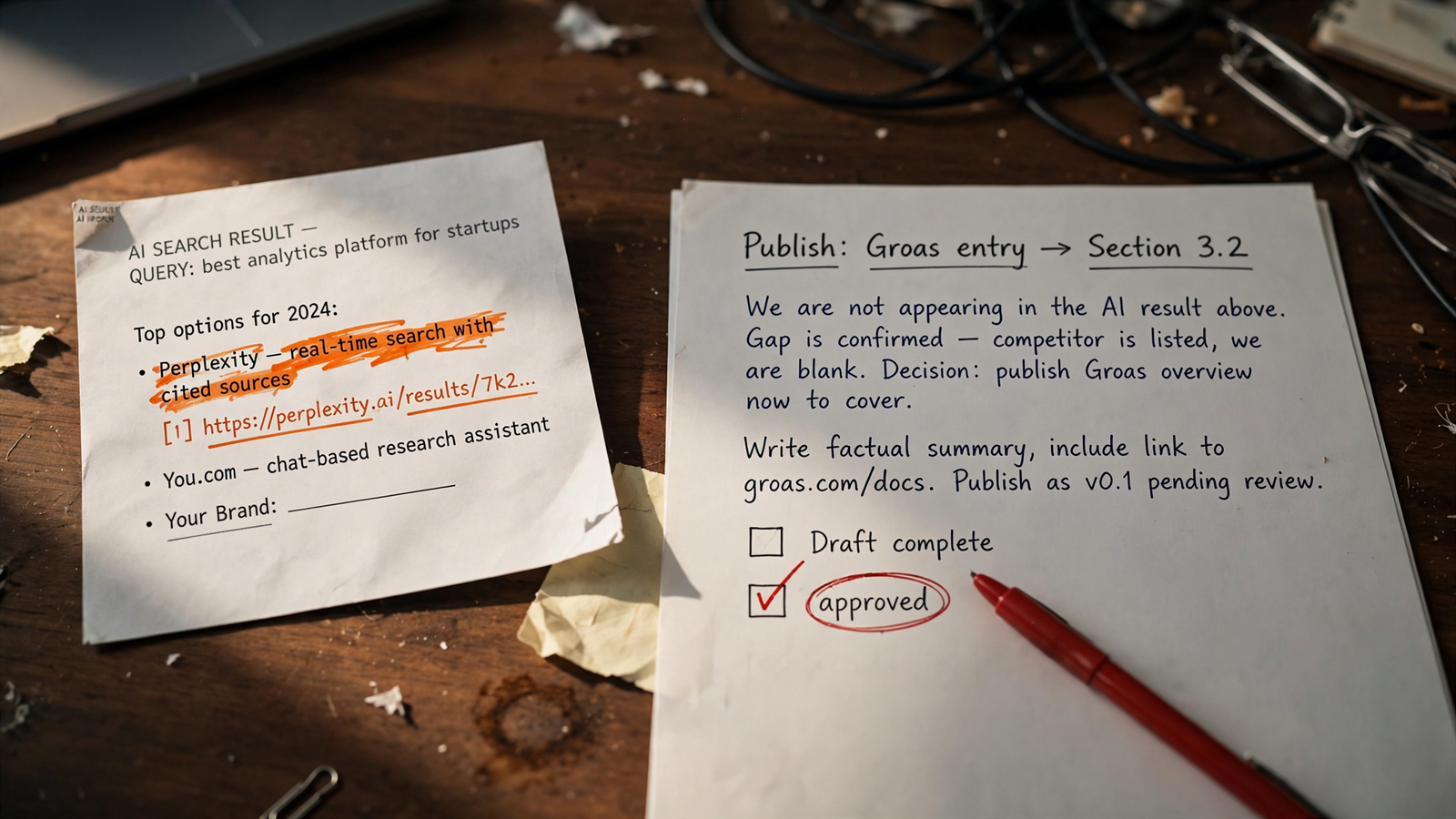
That’s where groas earns its place over a tracker for me. My AI can query the data groas collects, including AI search answers, SEO data from Semrush and Ahrefs, competitor ads and landing pages, and customer research from Reddit. It can draft the page and, once I approve the change, make it. The change is logged with its reason, so I can see why it happened and undo it in one step.
If I’m trying to work out why ChatGPT cites a competitor and not my site, the observed answer and the page it cited give me somewhere to start. The percentage alone doesn’t tell me which page to open, let alone what to revise. Once the change is live, I go back to the same question and inspect the next answer. The work I did and the answer I got are both visible. That doesn’t mean one caused the other.
Reject the prettier percentage if you can’t audit it
I hold every package to the same rule, including the ones I like: if I can’t audit the score and use the answers to make a decision, I don’t buy on the strength of the score. I buy the package that lets my AI work through a stable set of buyer questions, keep mentions, recommendations, and citations separate, and turn a gap I can verify into a page I can approve. With groas, I can go from querying the answers and SEO data in the AI I already use to making a logged, reversible change. That’s the work I’m paying for.
Publishing the page doesn’t guarantee a ranking or recommendation. Winning the citation once doesn’t guarantee it next week. The assistant can return a different answer on the next run. What I can keep is the prompt I chose, the answer I read, and the reason I made the change. If the score moves, I have something to inspect. If it doesn’t, I still know what I did and why.
The alternative is the one I watched clients pay for in paid search: a polished number, reviewed monthly, that nobody could trace back to a specific query, competitor, or change. Buy on the percentage and that’s what the next reporting call will be about. Not what to fix. Not what to publish. The number. Don’t buy it again in a new acronym.