LinkedIn

Your AI share-of-voice score can go up in the same month a competitor takes the three answers your buyers use to make a shortlist. The dashboard calls that progress because it counts the extra mentions and misses what you lost.
I spent years watching PPC accounts pull the same trick: spend more, generate more leads and make less money because the extra volume came from the wrong queries. AI visibility tracking gives that mistake a cleaner dashboard. Being named the default choice in a pricing comparison and being named the expensive option in a generic how-to can both count as mentions. They do not do the same job.
Say you add informational prompts and start showing up in broad explainers across ChatGPT, Claude and Google AI Mode. Meanwhile, a competitor gets recommended on three product-comparison prompts your highest-intent buyers ask, and the answers cite its pricing page. The average goes up. You’ve lost ground exactly where you wanted to gain it.
Stop optimizing the average. Optimize the buyer question, the offer and the cited source. That’s where I look for the evidence that tells me what to publish, what to update and what to leave alone.
How the average hides a loss
A share-of-voice score can tell you what fraction of tracked brand mentions belong to you. It can’t tell you whether you gained ground on the same buyer questions unless you know what went into the calculation. Start with three things the headline number leaves out:
- Which prompts count. In one 1,750-answer matched study, branded prompts named the tracked brand in 92.1% of ChatGPT answers and 93.0% of Perplexity answers. On discovery prompts, those rates were 11.3% and 14.7%. Blend the two and the headline named rate lands around 40–43%. A model repeating the name you put in the question is not the same thing as a buyer discovering you.
- Whether the panel changed. In one worked example, adding eight prompts about a feature the brand already wins lifts the headline score four points. Performance on the original 40 prompts stays flat. The report says you gained ground. The buyers asking those 40 questions see nothing new.
- What each prompt weighs. In Ahrefs’ weighting example, every brand appears on two of three prompts and gets a basic score of 67%. Weight the prompts by AI-adjusted volume and the example brand drops to 31% because its mentions sit on the less-asked questions. Same appearances. Different verdict.
Then there’s sampling. At 100 runs per prompt, a measured 30% share comes with a 95% confidence interval of roughly 21–39%. One run gives you an answer, not a rate. In a test that ran 12 prompts 2,961 times, SparkToro and Gumshoe.ai found less than a 1-in-100 chance of getting the same brand list twice. One operator in r/DoSEO ran 84 buying prompts twice in ChatGPT on the same day and found that only about a quarter of the shops in the product cards appeared in both runs. A weekly single run is not a trend line. It’s a coin toss with a logo on it.
Before I call a rise progress, I want the prompt list, the denominator, the weights and the number of runs. If the panel changed, show me the old panel on its own.
Another tracker won’t tell you what to publish
I’ve watched agencies send PDFs showing that spend and CPA both went up without saying which keyword, ad or landing page to look at. The AI search version is a slide that says share of voice up two points without showing a buyer question, a cited competitor page or the page we might fix. Nice slide. What am I supposed to do on Monday?
In the World Federation of Advertisers’ 2026 research, 73% reported monitoring AI visibility, but only 8% had a clear strategy for it. In the same survey, 45% cited technology integration and interoperability as a top barrier, and 37% cited data quality and access. That doesn’t prove connecting your tools earns citations. It does explain why I wouldn’t start by buying another score: the score lives in one tool, the answer text in another and the page I need to fix in a third.
I want the evidence and the page decision in the same place. Otherwise I’m paying to report the number and still doing the work of figuring out what it means.
Make Claude show what the score is made of
With Claude and groas, Claude is the brain and groas is the hands and the data. I start by asking for the split I actually need, not a prettier version of the headline:
Using groas, split our AI visibility by offer, buyer stage and assistant. Show the tracked prompts and denominator behind every percentage.
The prompt list shows whether branded questions are padding the result or someone swapped the panel this month. The denominator shows what each percentage counts. The split by offer and stage keeps a pile of informational mentions from hiding a blank in the pricing comparisons. If I have 60% of informational mentions and zero pricing-comparison recommendations, I know which gap I’m looking at first. If Claude hands me another average, I send it back.
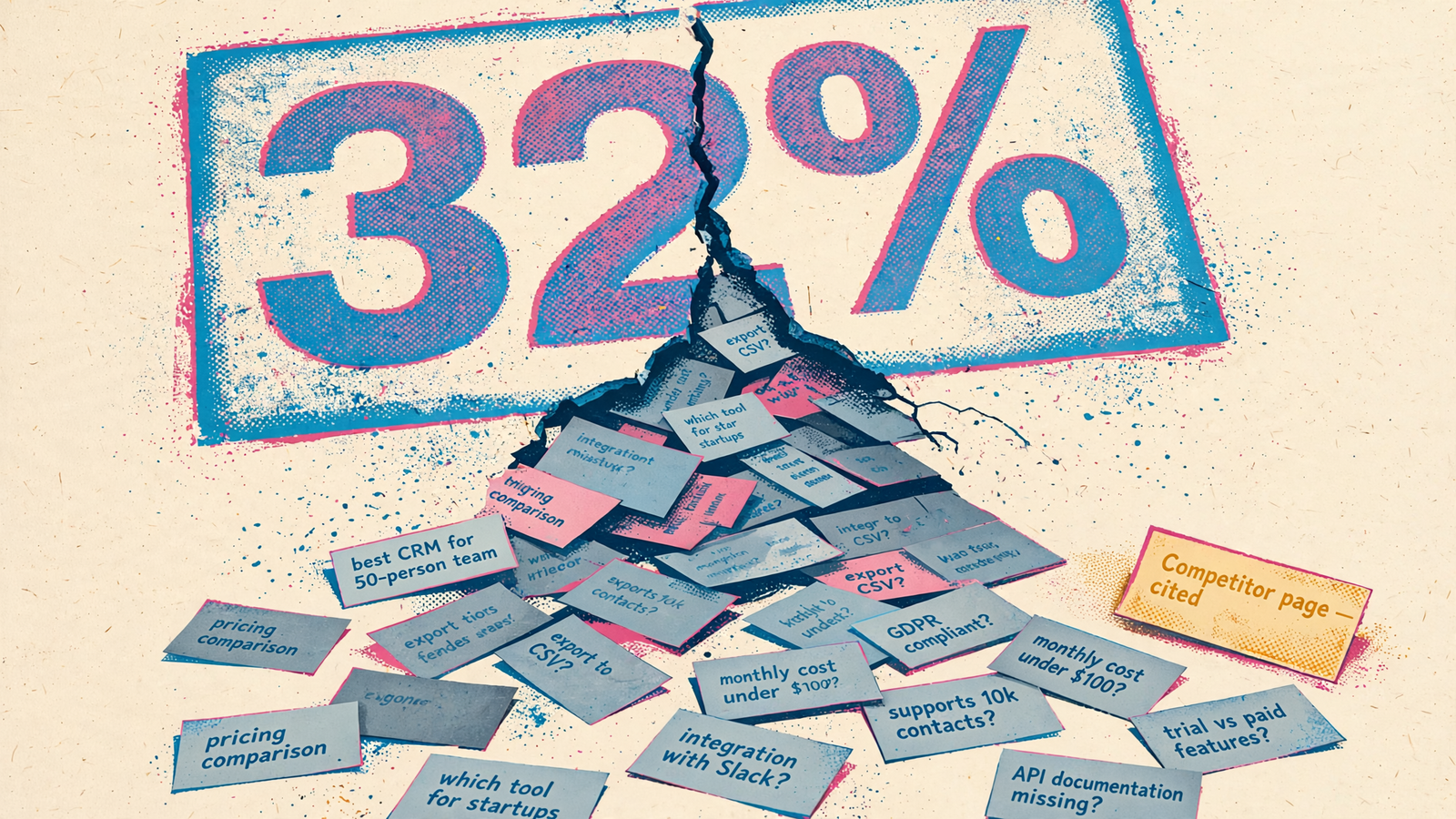
The next split matters more: a mention, a recommendation and a linked citation are three different events. Peec AI’s definitions distinguish the share of responses where a brand appears from its share of tracked brand mentions. They also distinguish a brand named in prose from a source cited by URL. That’s useful because an assistant can name me as the expensive option, recommend a competitor and cite my page. I don’t want those three things added together and handed back as a win.
Nor do I assume every recommendation comes with a link. In one analysis of citation coverage, ChatGPT returned zero citations on 57.8% of runs, and Claude surfaced few linked URLs. Keep the events separate in the report: a mention tells me I appeared, a recommendation tells me the answer pointed the buyer my way, and a citation tells me which page the answer linked. I optimize for the last two. The first is background noise.
Turn a missing recommendation into a page decision
Once the average is out of the way, I want Claude to connect the answer I’m losing to a page I can actually change:
For our missing buyer prompts, show cited competitor pages, relevant Search Console queries and our nearest existing page.
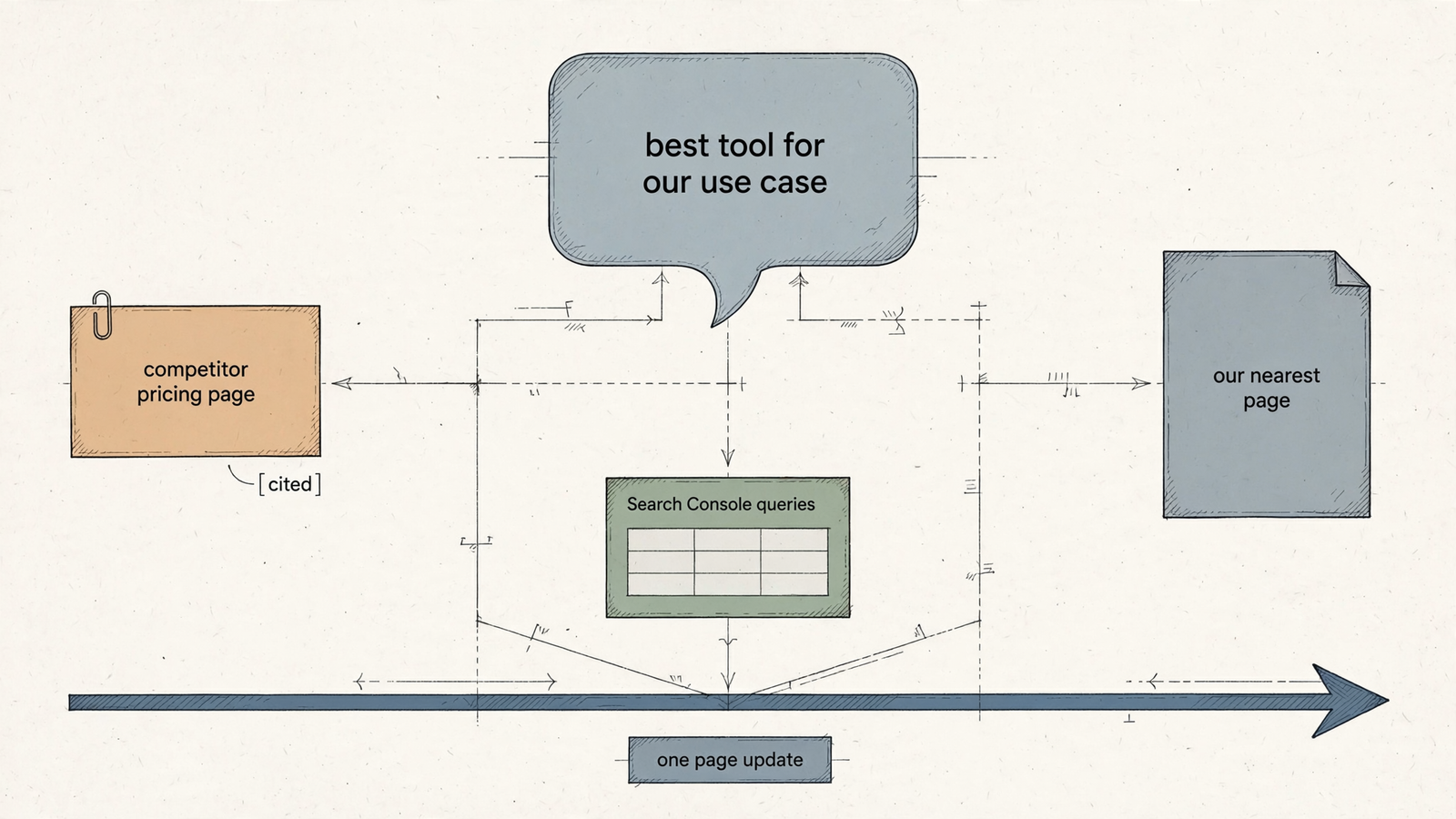
Put the buyer question, the cited competitor page and your nearest page side by side. The question tells me where I’m missing. The citation gives me a specific page to inspect: a pricing page, a comparison table or a support doc, not just a competitor’s domain. Search Console gives me a way to check for related queries and see which of my pages already show up for them. It doesn’t tell me how often anyone asks the assistant that exact question.
Say my nearest page is a 4,000-word blog post that never mentions price. The cited competitor page answers the pricing question in the first three lines. I don’t need another chart to tell me my page dodges the question. Updating it won’t guarantee a citation, but it will fix the thing I can see and control: the page doesn’t answer what the buyer asked.
Save the underlying answers as you go. In Otterly’s 320-prompt, 30-day dataset, up to 67% of cited sources appeared on only one day. ChatGPT and Google AI Mode retained about a quarter of the previous day’s citations, compared with about three quarters for Perplexity. A link popping in or out is a reason to look at the answer again, not a reason to declare the edit a success or a failure.
I use HubSpot’s methodology checklist to ask what a tracker actually captures: where it runs the prompts, how often it samples them and whether it separates pages read to synthesize an answer from links shown in the answer. If those are different events, I want them recorded that way before I make a publishing call.
Fix the buyer gap even if the score falls
If I start winning the three comparison prompts that matter and lose ten mentions on trivia my buyers never ask, the headline score can fall. I’ll take that trade. The score is a diagnostic. The buyer question is the job.
That doesn’t mean publishing a page controls the answer. In a 158,099-answer study, pages ranked first were cited 43.8–57.1% of the time, versus 3.5–8.3% for pages ranked 11–20. FAQ blocks and schema showed no significant effect within websites in that study. I read that as a warning against on-page polish theater. Publishing is a bet that the assistant can find the page and will cite it, not a way to make it do either. So I ask Claude to make the case before I spend the time:
Propose one page update supported by this evidence. Show sources and uncertainties. Do not publish until approved.
One page. Sources shown. Nothing goes live until I approve it. When I let groas act on my AI’s instructions, I want the change logged with its reason and the option to undo it. And if the evidence doesn’t support updating the nearest page, “don’t publish yet” is a decision. I don’t need Claude to invent work to justify the report.
For a starting panel, I use 48 buyer prompts to paste into Claude. A generic “best CRM” prompt might tell me I appear somewhere in a long answer. Category, comparison and pricing questions tell me whether the answer recommends the offer when money is on the table. Once I’ve picked the questions, I keep the prompt panel fixed for period comparisons and report additions separately. Otherwise I can’t tell a change in the answers from a change in what I measured.
I’ll put GA4 outcomes beside the answer data for context. I won’t claim a citation caused a sale because revenue moved in the same period. A seasonal offer, a price change or the comparison page I fixed three weeks earlier could explain the lift. I write that in the report so next month’s version doesn’t quietly turn a coincidence into a case study.
Keep the score. Stop paying people to move it.
I’ll keep a headline number on the wall if it helps me spot a sudden change. I’ll pay for the work the number can’t do: keep the panel stable, split the answers by offer and buyer stage, separate mentions from recommendations and citations, and tie a publishing decision to the cited competitor page and my nearest existing page. A tracker that flags the move and leaves me to do the rest has sold me a chart.
After an approved change, I go back to the underlying answers. If the comparison prompt now recommends me and cites my pricing page across repeated runs, I have evidence that the answer changed. If the score moved and those answers didn’t, I have noise wearing a suit.
groas Unlimited costs $19 a month, flat for the whole team, with unlimited teammates, ad accounts and websites, every feature and all the data, including AI search answers and competitor data collected 24/7. Agencies pay the same for every client. I’d rather pay to connect my AI to the accounts and evidence, make an approved change and log why, than pay for another score I can’t act on. If I want to hand the work over, Done For You starts at $5,000 a month and is run by the senior team. The test stays the same either way.
Ignore it and the score can keep climbing on questions nobody buys from while a competitor takes the recommendations that decide deals. That’s not a visibility strategy. It’s a way to feel better about losing.